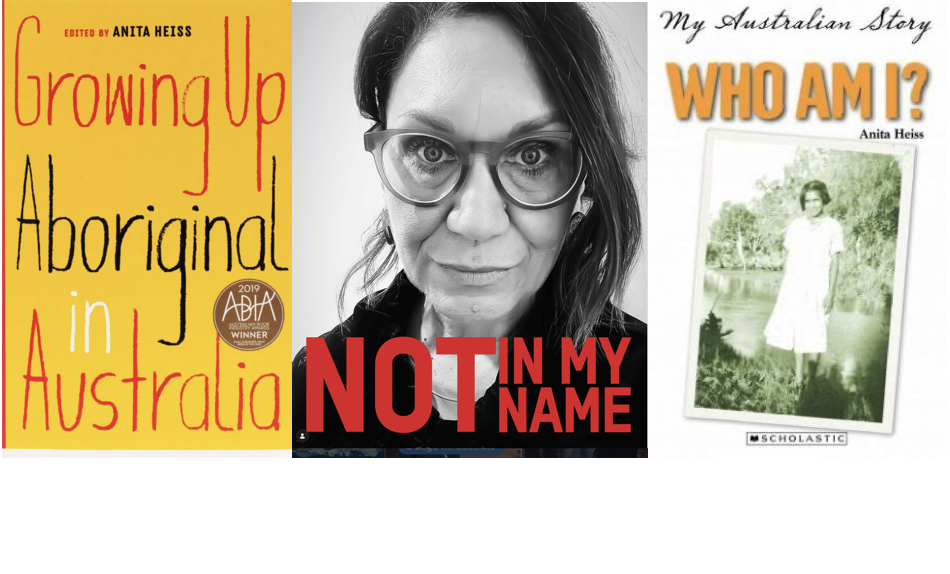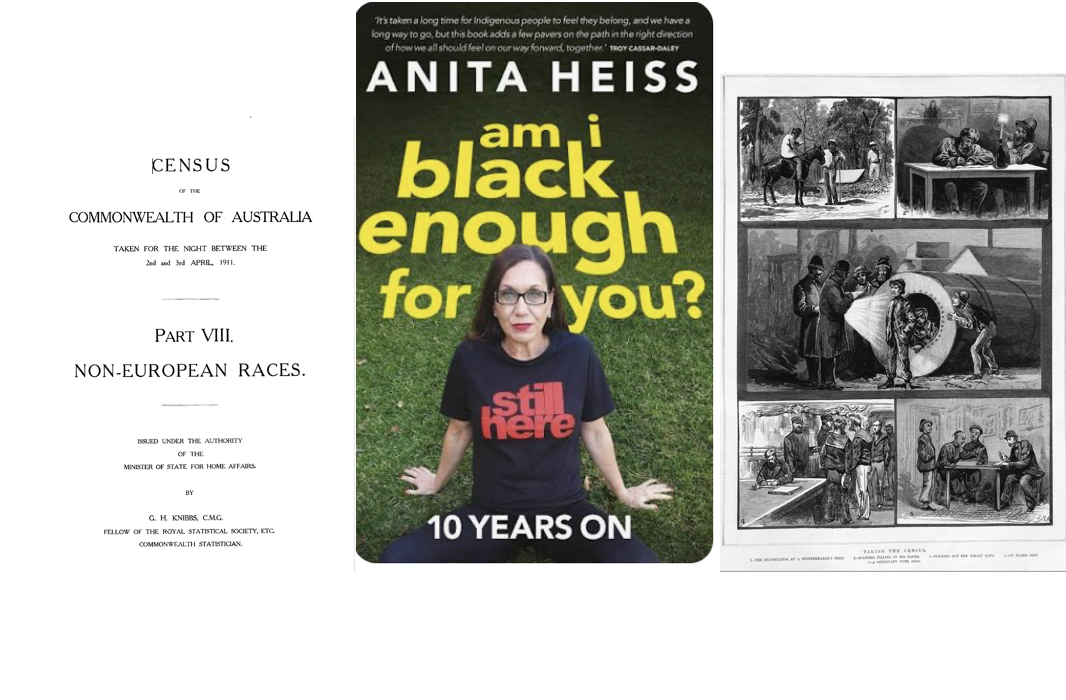
Anita Heiss - We weren't Counted. Really?
Posted 7 August 2026
This is Part 3 in our series, We need to Talk About Anita (see Part 1 here and Part 2 here).
Just to reiterate on the methodology I am using here: readers should not take this post as a personal critique of Dr Anita Heiss herself.
Rather, the methodology I have developed at Dark Emu Exposed is to use the writings, life stories and opinions that prominent people themselves, such as Dr Heiss, have freely put into the public square, as a way to critique the claims they frequently make against my Australia. For invariably, I find their criticism of my Australian society and its history is often just identity group activism on their part, with the political motivation that entails - it is frequently unfair, unjustified or even just plain wrong.
This post continues my theme of looking at Dr Heiss’ writings as a political tool, which she feely admits when discussing her anthology of Aboriginal writing:
“I write obviously in the coloniser tongue, and I still enjoy that writing. For me it's sort of um, I enjoy it because I'm writing I'm using the coloniser’s language to write about what they have done to us and then that written piece about assimilation or colonisation or attempted genocide or the struggle for survival, which is all in the anthology, then goes back to the UK for readers over there to read; so to me there's some sense of joy in that.”
- Dr Anita Heiss, 2009 (See video)
In this post, I want to show how Dr Heiss’ political writings denigrate Australia and its history by considering the example of her imprecise discussion of how Australia’s Aboriginal population was enumerated in the past.
Heiss is an adherent to the Aboriginal activist’s political trope, “we were never counted”, a reference to Section 127 of the Constitution which reads:
In reckoning the numbers of the people of the Commonwealth, or of a State or other part of the Commonwealth, aboriginal natives shall not be counted.
This s 127 was repealed by referendum in 1967 (See Yes/No pamphlet from 1967).
Like Dr Heiss, many Aboriginal activists, such as Professor Marcia Langton AO, seize upon this repeal as evidence that Aboriginal people were, ‘not citizens until after the 1967 Referendum’ (p2).
Similarly, the 2017 Aboriginal political manifesto, The Uluru Statement from the Heart, contains the phrase, ‘In 1967 we were counted’, which leads the reader to believe that Australia was so racist that it wasn’t until the 1967 referendum, which removed s 127 from the Constitution, that Aboriginal people were finally counted in Australia’s census.
Former Labor Minister for Indigenous Australians, Linda Burney, was a frequent purveyor of this trope:
I was born at a time when the Australian government knew how many sheep there were but not how many Aboriginal people. I was 10 years old before the ’67 referendum fixed that. - (Ref. 2 and see also here)
Academics are no less immune to the spreading of this misinformation:
In 1967 a national referendum, passed by an overwhelming majority of Australians, determined that the original Australians should be counted in the census. (Ref. 1)
This trope is classic, politically-inspired misinformation, even disinformation, designed to slur Australia, its history, its people and their constitution as ‘‘racist’.
Dr Heiss spreads a variant of this disinformation when she writes that cattle were counted in Australia, but not Aboriginal humans (Figures 1A&B).

Figure 1A - Source: Ref 4 , p77
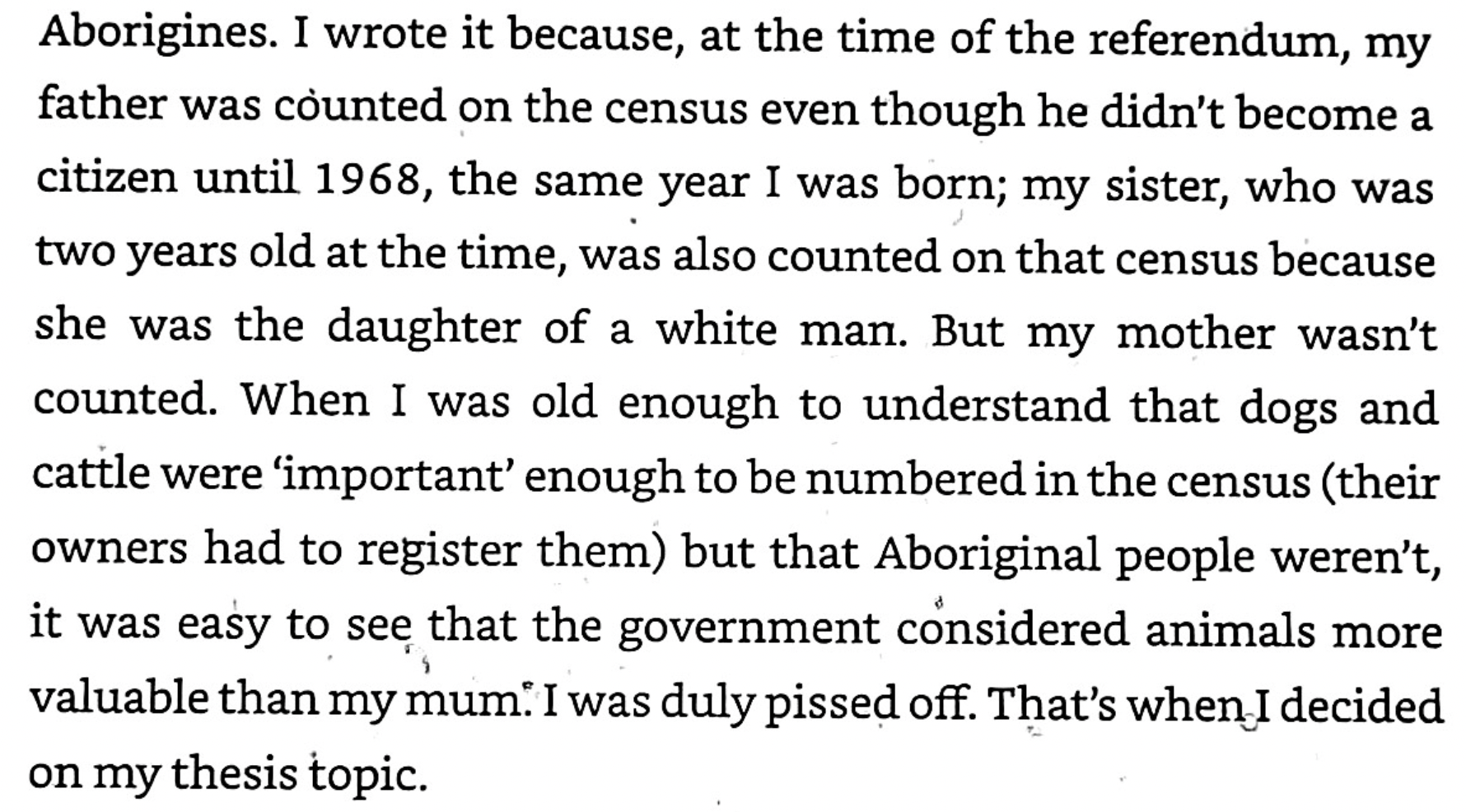
Figure 1B - Source: Ref 4 , p78
Heiss repeats these misleading tropes in an article she wrote in 2013:
[In] 1967 when an overwhelming majority of Australians voted to included Aboriginal people in the census of their own country. The referendum finally recognised Aboriginal people as citizens in their own land.
- Dr Anita Heiss (Figure 2). [See also Further Reading 3 below]

Figure 2 - Excerpt from a news article by Anita Heiss, Government policy in relation to Aboriginal people, Barani, Sydneys Aboriginal History , 11 June 2013. Source
1. The Evidence to Refute Dr Anita Heiss’ Claims
1.1 - The Constitutional Questions
First, the reality is that Aboriginal people were included in a general sense in the main sections of the Australian Constitution along with other Australians. The preamble includes Aboriginal people as part of “the people of New South Wales”. This would have included Heiss’ family - the Williams and Tallance families in 1901:
WHEREAS the people of New South Wales, Victoria, South Australia, Queensland, and Tasmania, [WA was added later] humbly relying on the blessing of Almighty God, have agreed to unite in one indissoluble Federal Commonwealth under the Crown of the United Kingdom of Great Britain and Ireland, and under the Constitution hereby established: (Source)
In the modern world of identity politics, Heiss’ implication that Aboriginal people were not included in the Constitution of 1901 in a direct way is a furphy. The word ‘Aboriginal’ was mentioned twice - in s 51 (xxvi) and s 127 - in the original document. Compare this to other groups Australians coming under the banner of ‘the people’, such as ‘‘women’, ‘white or European men’ and ‘migrants or immigrants’ - none of these people were mentioned once by name. Does this mean the later three categories of Australians were not included in the Constitution? Of course not.
Second, it is true that some Aboriginal people did have some of their citizenship rights curtailed, especially in the laggard states of Queensland and Western Australia, but the understanding of this is blurred today by confusing who was actually considered Aboriginal in law in the early 1900s.
For example, those few Aborigines who had restricted citizen rights were mostly full-blood Aboriginal people, often living in very remote places. It would have been deeply unfair, and indeed impractical, for the government’s census-takers and the electoral commission to be forced to travel to out to the desert to accurately count these people in the census, or register them on the electoral rolls.
It was an offence for Australians not to partake in the census, or fail to enrol to vote [compulsory enrolment commenced in 1912 & compulsory voting in 1924]. What were the authorities to do? Sack the bureaucrats for not going out into the desert to locate and ‘count’ these pre-contact, illiterate Aboriginal nomads who were still living a traditional life? Were these remote Aborigines to be fined for failing to undertake their citizen responsibilities by enrolling and voting?
Some other Aborigines were considered wards of the state receiving government benefits and, as such, one citizenship right they did not receive was the right to vote (See Further Reading 3 below for a discussion on the problems in determining these rights).
These are the realities that Aboriginal activists today, like Dr Anita Heiss, fail to explore. In addition, she has never seemed to address Kings Counsel Stuart Wood’s observation that:
“The definitional change [of who is an Aborigine] from the ‘preponderance of blood’ test to the tripartite test (together with increasing incentives – both societal and financial – encouraging Aboriginal self-identification) means that the ‘we’ of the Uluru Statement are not the same ‘we’ excluded by s 127.
In other words, perhaps 90% of the 812,728 persons who currently self-identify as Aboriginals would not have been excluded by the ‘preponderance of blood’ test and would have been included in the s 127 constitutional count.” (Ref 3, p10-11)
Thus, Dr Heiss is arguing at cross purposes to my critique - if she had been alive in 1901 she would not have been subject to any restrictions under s 127. People like Heiss, with one Aboriginal and one non-Aboriginal parent were not excluded by s 127. (Ref 3, p9).
Any histrionics Dr Heiss displays today about Aboriginal people (that is, in her mind, herself) not being counted “in reckoning the numbers of the people of the Commonwealth” is a moot point because, as a part-Aboriginal, she would have been counted in 1901.
1.2 - The Population Census Question
When we were finally recognised in the census in 1967 …
- Dr Anita Heiss (Figure 3)

Figure 3 - Dr Anita Heiss claims Aboriginal people were not recognised in the census until 1967. Source: Ref 4 , p121
If this claim by Dr Heiss is true, why then do pre-1967 census forms include a specific section that allows Aboriginal Australians to state their “race”?
For example, Section 13 of the 1966 census form asks: “State each person’s race” with available options such as “Aboriginal”, and for persons “of more than one race give particulars, for example, 1/2 European, 12 Aboriginal…” (Figure 4).

Figure 4 - Extract of Sections 10 to 13 of the 1966 Australian census form. Source: Full form here
The form for the previous census in 1961 has a different layout but essentially asks the same ‘race’ question, allowing Aboriginal Australians to clearly state their Aboriginality as “Aboriginal” (ie ‘full-blood’ with two Aboriginal parents), or “H.C.” (‘Half-caste with one Aboriginal parent only) (Figure 5).
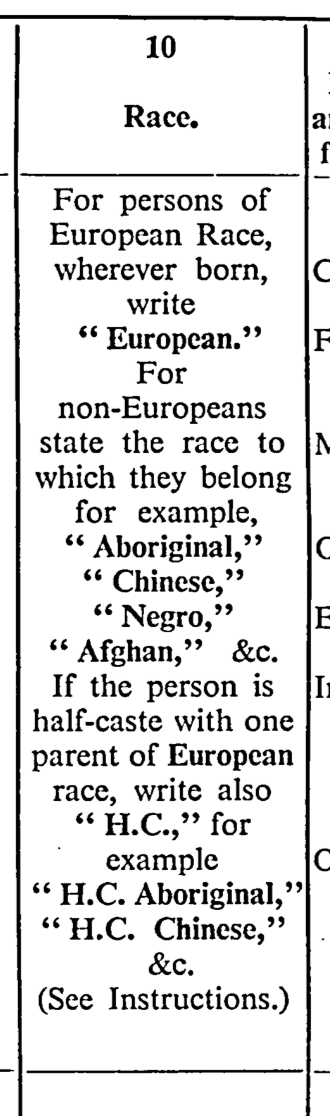
Figure 5 - Extract of Sections 10 of the 1961 Australian census form. Source: Full form here
Clearly the Commonwealth Bureau of Census and Statistics (CBCS)[after 1974 known as the Australian Bureau of Statistics (ABS)] was ‘counting’ Aboriginal Australians.
Furthermore, these census counts of Aboriginal people were published in the next edition of the Commonwealth Year Book. For example, based on whether Aboriginal citizens entered themselves as “Aboriginal” or Half-Caste “H.C.” in the 1961 census, their enumeration, or ‘count’, was tabulated as either “Full-Blood” or “Other” in the Commonwealth Year Book of 1966 (Table in Figure 6).
All Aboriginal people, no matter what degree of Aboriginal ancestry they had, were thus ‘counted’ in the census of the Aboriginal population of Australia.
This evidence suggests claims by activists such as Dr Heiss are simply wrong - they constitute misinformation if they are simply promoted mistakenly; or disinformation if they are promulgated whilst being knowingly untrue.
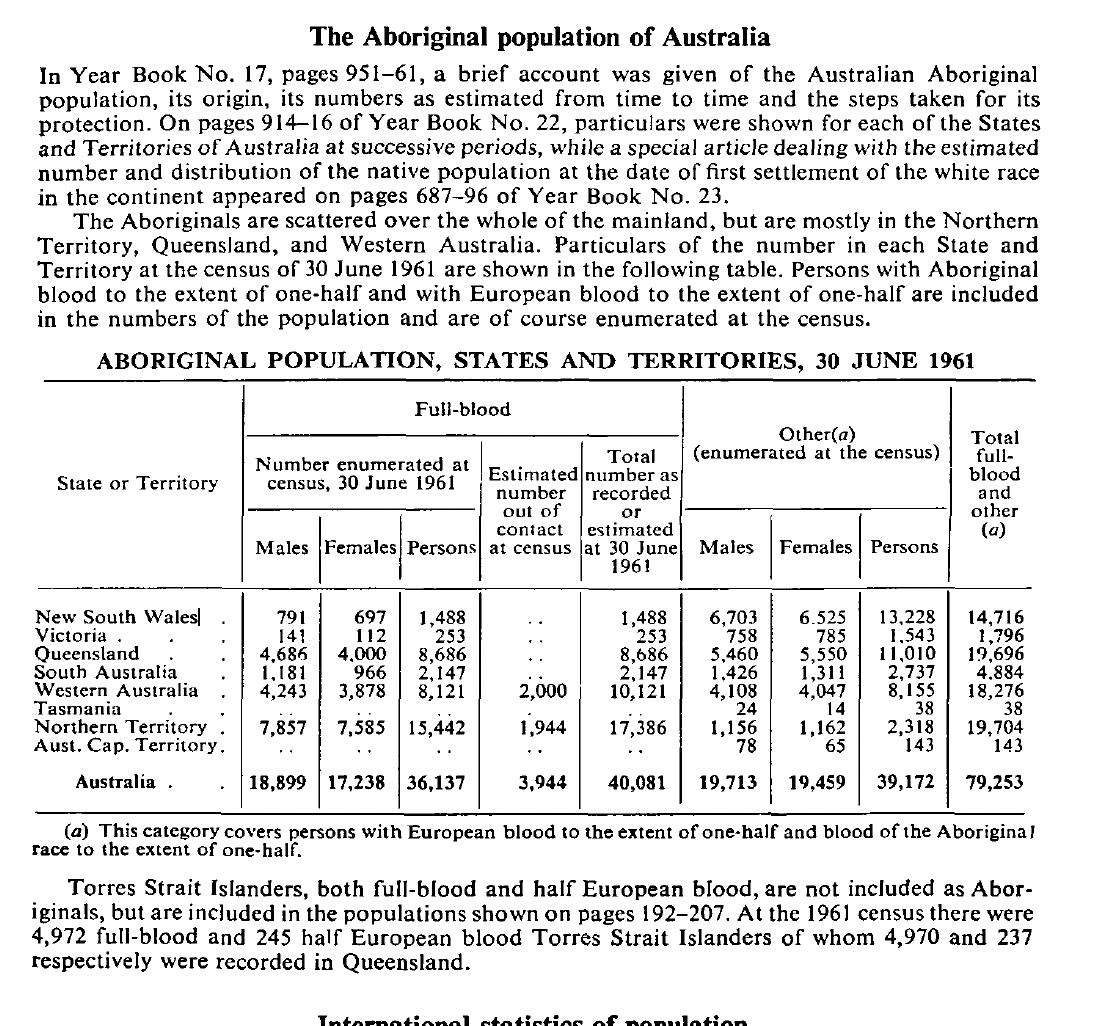
Figure 6 - Census of Aboriginal population 1961 for Aboriginal people - full-blood & 50% or less of descent, as reported in the Year Book of 1966. The numbers of Half-Caste Aboriginal people included in the “Other” column were also added to the country’s total population in another table in the Year Book as described in paragraph two above where they “are included in the numbers of the population and are of course enumerated at the census.” The “Full-blood” by comparison are counted and their numbers reported here, but they are not added to the numbers in the Total Population table elsewhere. Source: 1966 Year Book, p225
The ‘race’ question on the two census forms just prior to the 1967 referendum, 1961 and 1966, were found to be not that different from the “racial origin” question asked in the first post-1967 referendum census in 1971 (Figure 7).
Dr Heiss is thus somewhat misleading when she wants her readers to believe that the 1967 referendum was a turning point or watershed moment for justice in the government statistician’s treatment of Aboriginal people.
A comparison of census forms pre- and post-1967 show that the ‘race’ questions asked are pretty much the same over this period.
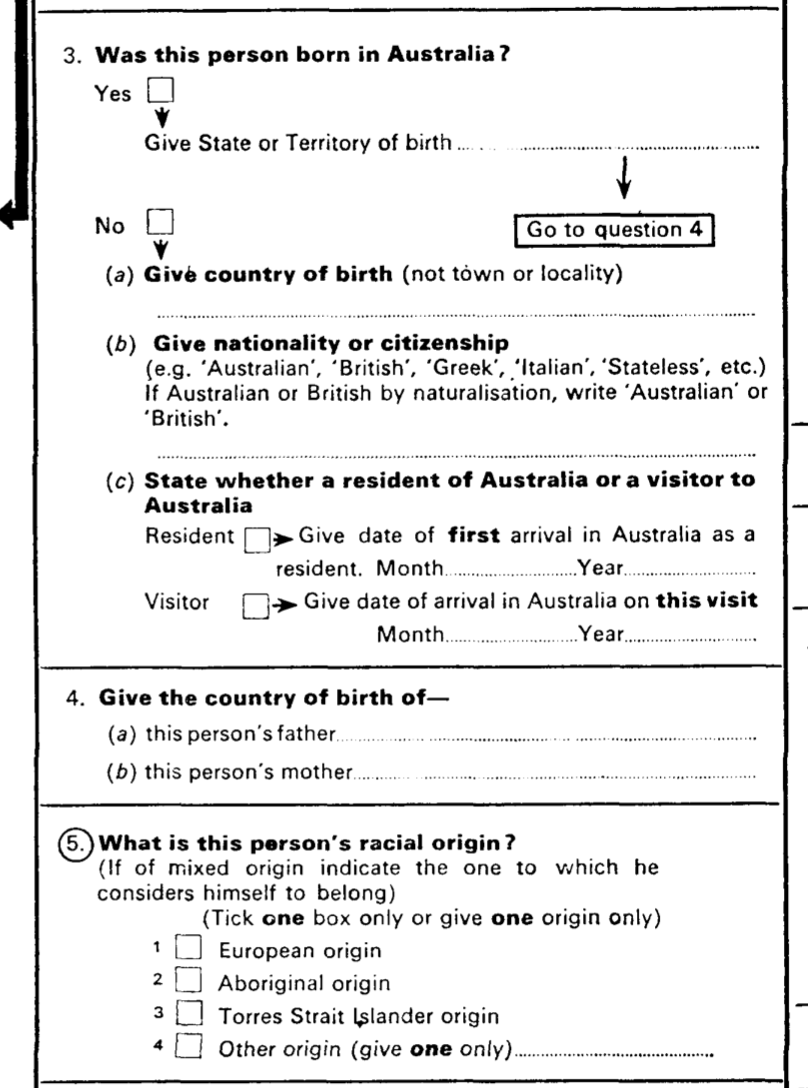
Figure 7 - Extract of sections Appendix 1.1 3 to 5 of the 1971 Australian census form. Source: Full form here
The Aboriginal population results gathered during each census were collated and published widely in the next respective Commonwealth Year Book. All public libraries and many (all?) school libraries carried the series of Commonwealth Year Books. Thus, the Aboriginal population figures were readily available to anyone in the public who cared to know.
The Year Book of 1968 for example, includes the census figures from 1954, 1961 and 1966 for ‘The Aboriginal population of Australia’ (Figure 8). As explained above, ‘out of contact’ Aborigines were not counted but estimated for reasons of practicality and access (see second last paragraph after Table in Figure 8).
If Dr Heiss wants to claim that ‘my mother wasn’t counted’ (Figure 1A), one needs to ask, “why not”?
Clearly, Aboriginal people in New South Wales, where her mother was born in 1937 and then lived, were being counted, as the census’s of 1954, 1961 and 1966 indicate (Figure 8).
Therefore, Dr Heiss would need to produce evidence that her mother failed to partake in the census’s from 1961, when she would have been aged 24 and considered an adult and thus required by law to complete the census, if she wants us to believe that her mother was ‘‘not counted’.
Her mother was raised a devout, law-abiding Catholic so one would suspect she would have diligently complied with her legal obligation to complete her census form, and thus be ‘counted’ in the Aboriginal population of Australia. How Mrs Heiss (nee Williams) answered the ‘race’ question in each of the census’s is not known.
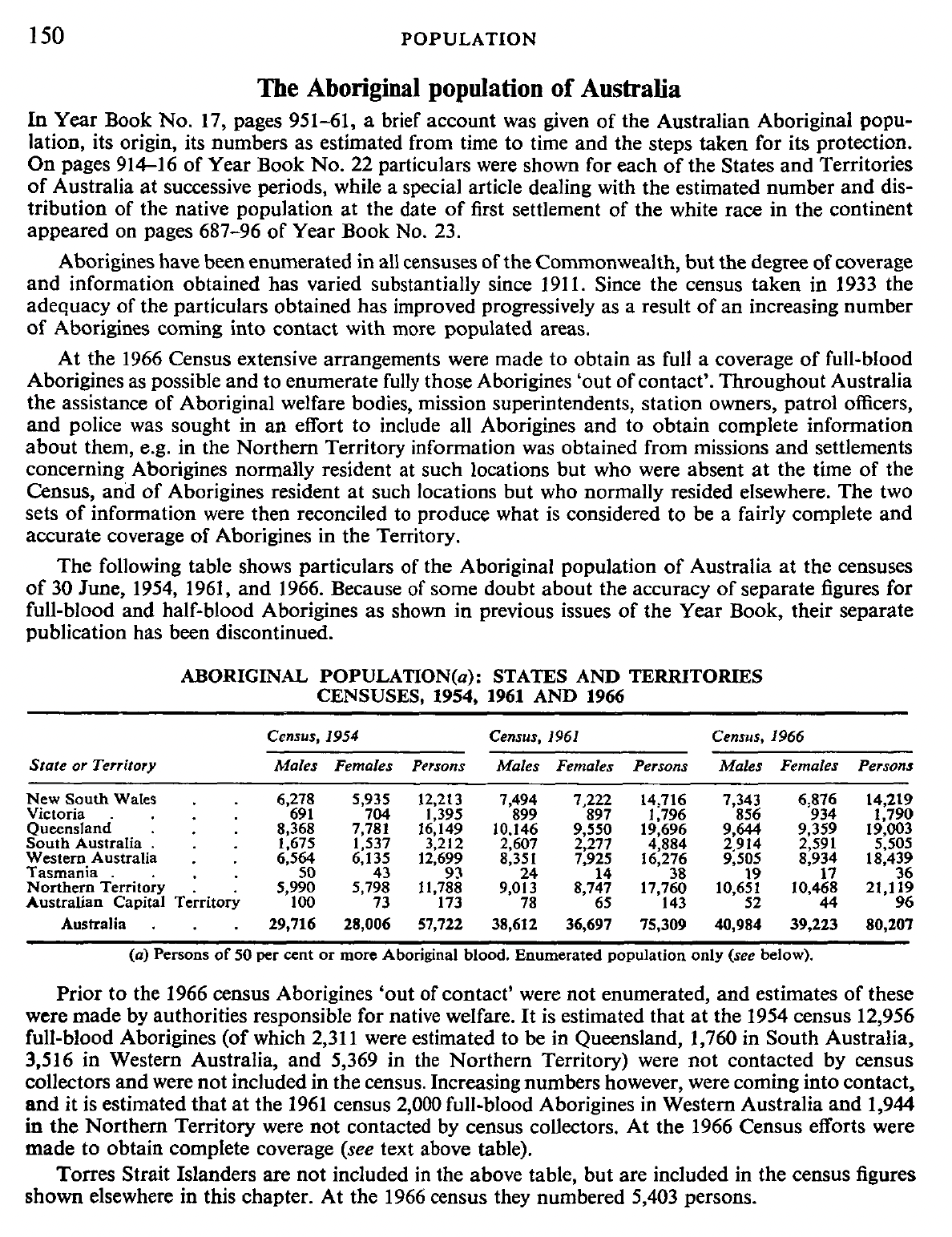
Figure 8 - Census’ of Aboriginal populations 1954, 1961 and 1967 for Aboriginal people of 50% or more descent, as reported in the Year Book of 1968 - Population.Source: 1968 Year Book, p150
1.3 - The Detail of An Aboriginal Census
The archival records also contain the "New South Wales Census of Aboriginals - 30th June 1941”. This is evidence that, even in the depths of the Second World War, Australia’s statisticians were doing their duty to perform the census. Dr Heiss’ ancestors, including her own mother Mrs Elsie Heiss (nee Williams), were most likely ‘counted’ within the census results for Cowra, where the Erambie Aboriginal reserve was located and her mother was born in 1937, and Tumut where many other extended family members lived (Figures 9A&B).
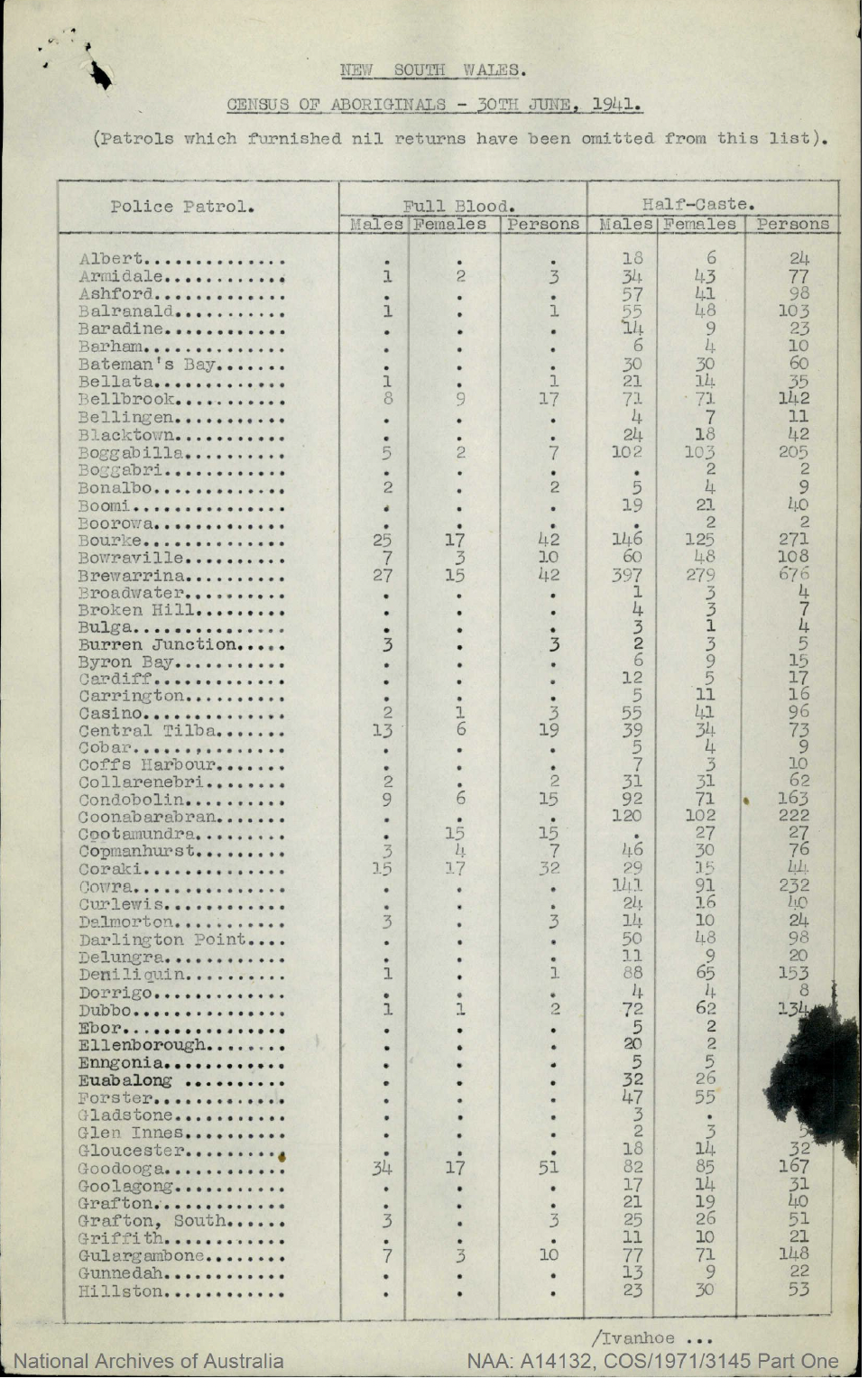
Figures 9A - Extract of the Original Census notes of 1941 for NSW Aboriginals - Full-Blood & Half-Castes including the regions of Cowra and Tumut where the Williams (Heiss) families lived. Source: NAA A14132, COS/1971/3145
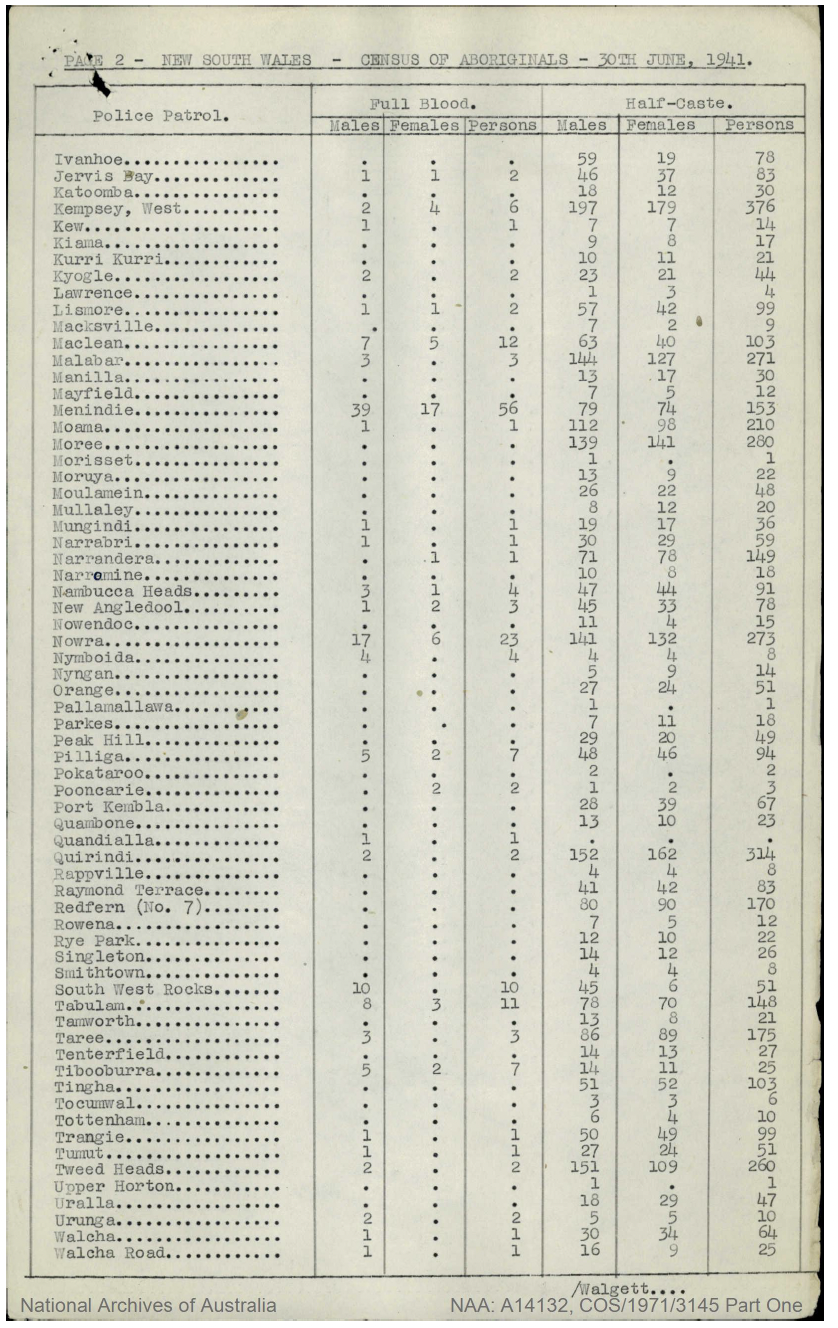
Figure 9B - Extract of an original Census notes of 1941 for NSW Aboriginals - Full-Blood & Half-Castes including the regions of Cowra and Tumut where the Williams and Tallance (Heiss) families lived. Source: NAA A14132, COS/1971/3145
1.4 - The Public Knew the Aborigines Were Counted in the Census
And not only did the government count Aborigines in the census but it publicised this fact. The Aboriginal population figures from the 1941 census were provided widely to the news media for publication (Figures 10A,B &C).
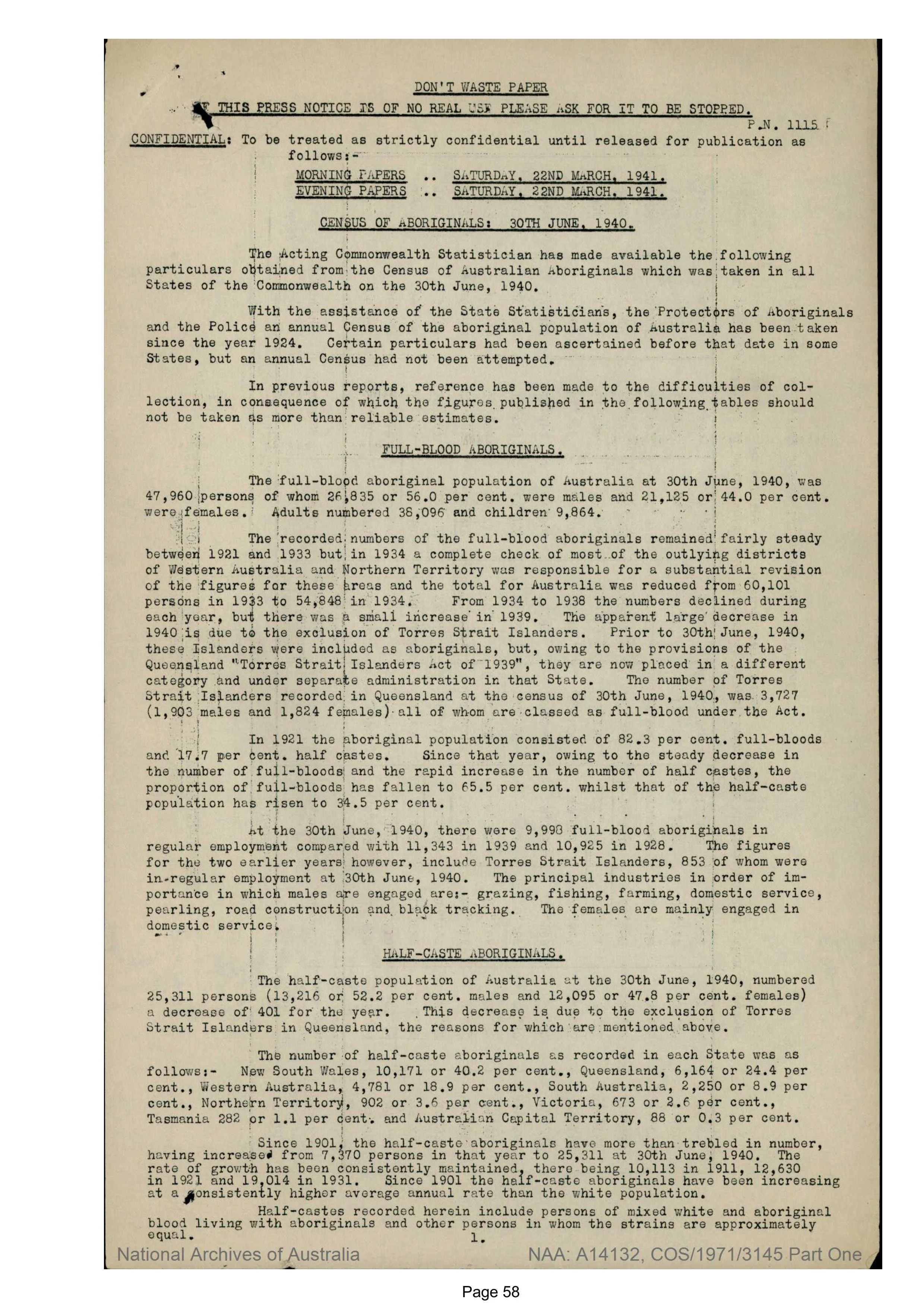
Figure 10A - Press Release for 22 March 1941 to the Morning & Evening newspapers publicising the Census of Aboriginals as of 30 June 1940. Source: NAA A14132, COS/1971/3145
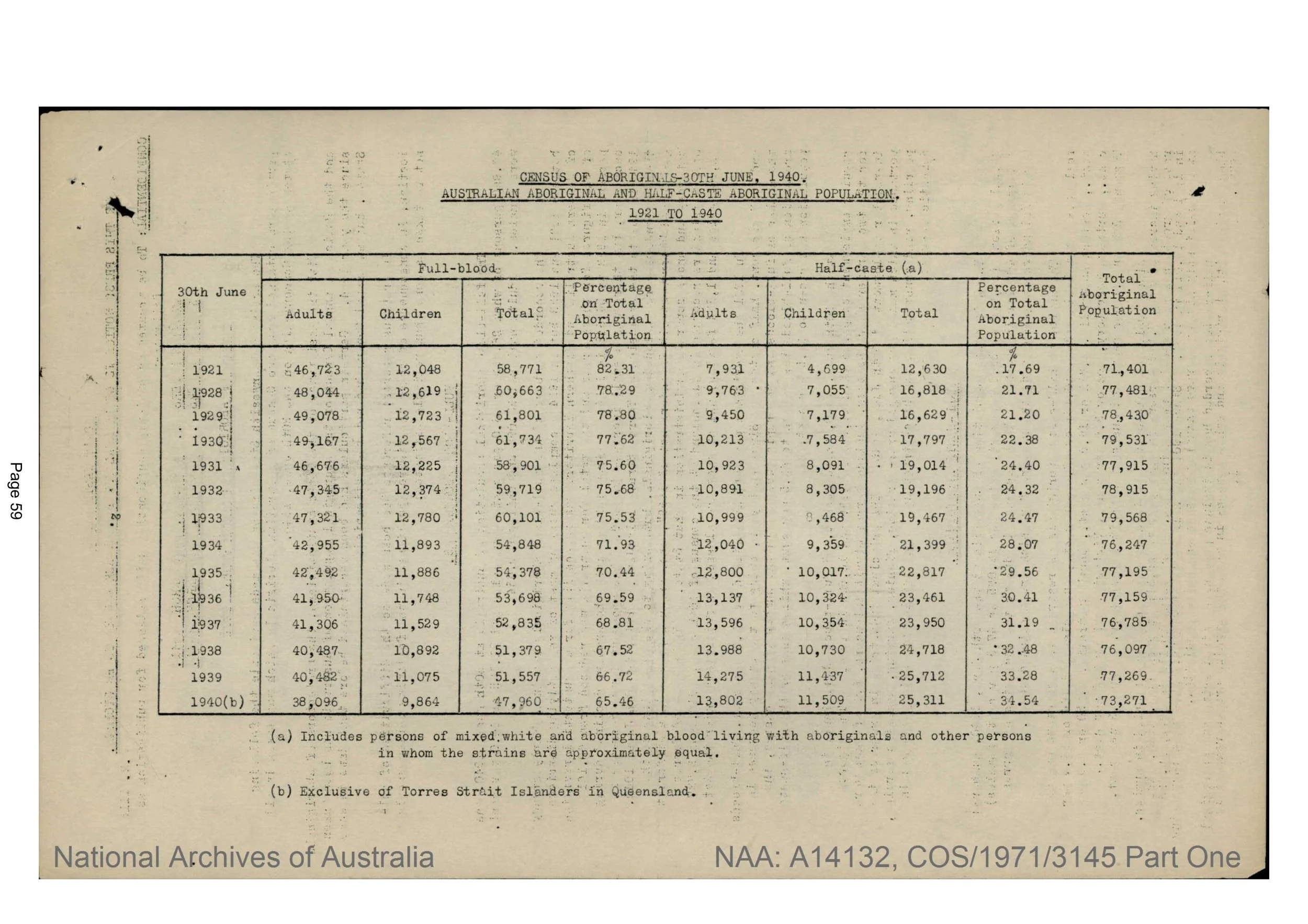
Figure 10B - Table accompanying the Press Release for 22 March 1941 to the Morning & Evening newspapers publicising the Census of Aboriginals as of 30 June 1940. Source: NAA A14132, COS/1971/3145
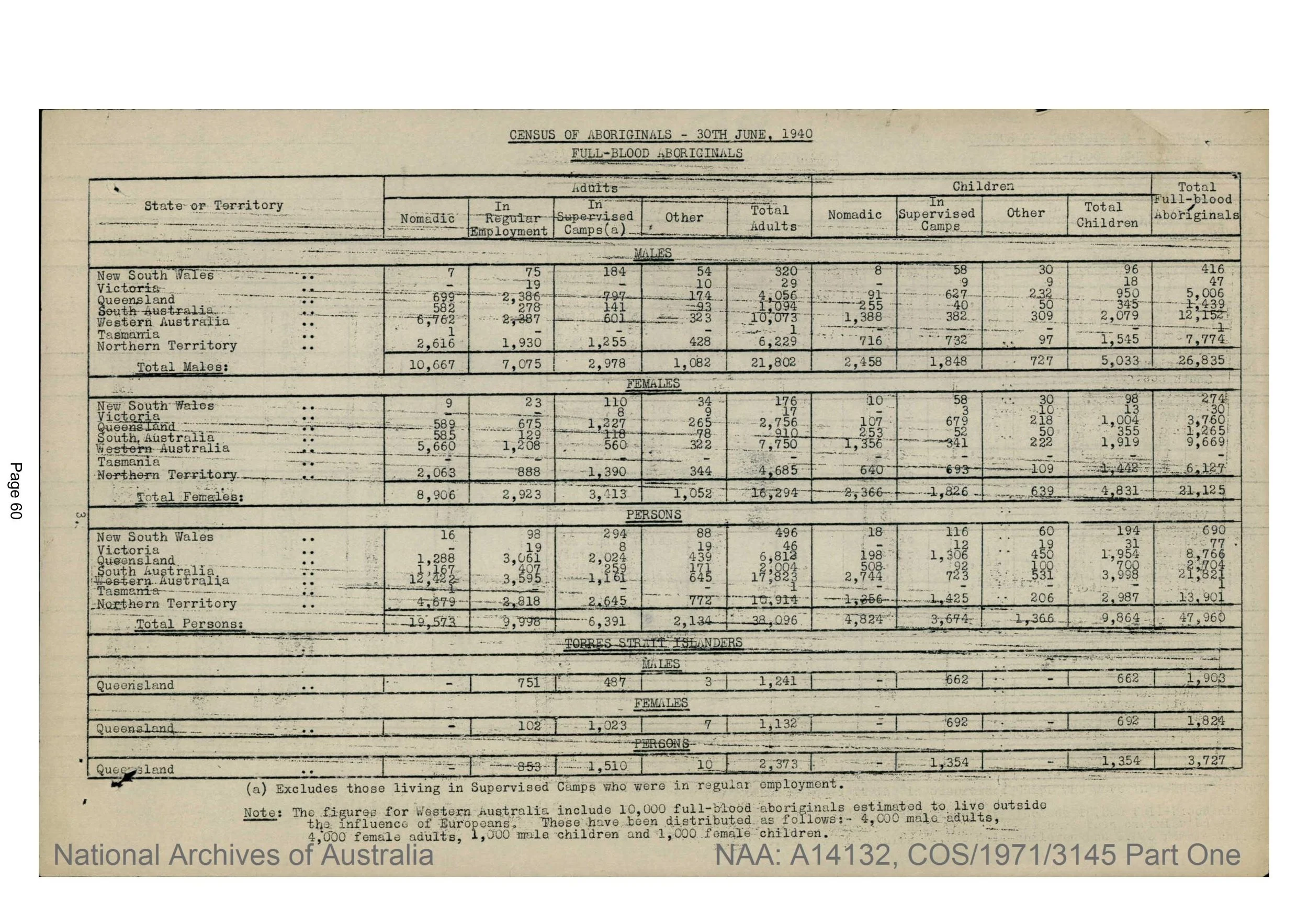
Figure 10C - Table accompanying the Press Release for 22 March 1941 to the Morning & Evening newspapers publicising the Census of Aboriginals as of 30 June 1940. Source: NAA A14132, COS/1971/3145
1.5 - The Aboriginal Census of 1921
Archival records are available that confirm that as early as 1921 the Government statistician was collecting population data on Aborigines from the census. Figures 11A,B&C detail some correspondence of October - November 1921 regarding the counting of Aboriginal people in New South Wales.
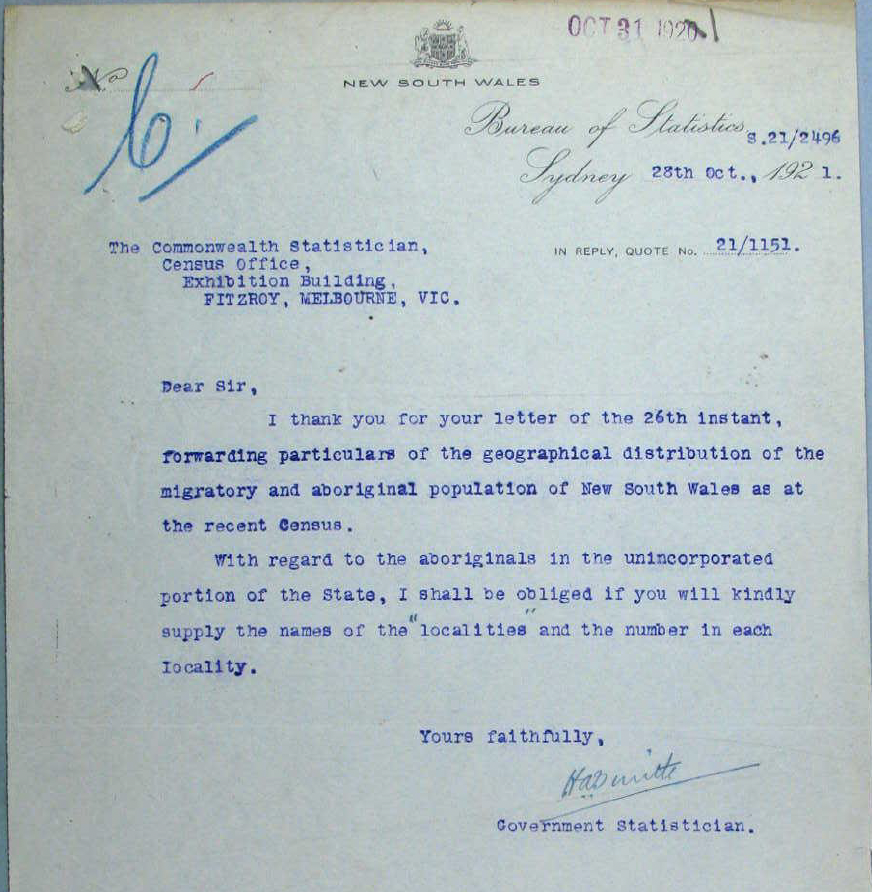
Figure 11A - 1921 Correspondence on “Census of Aboriginals” - Source: NAA: A9590, 49A
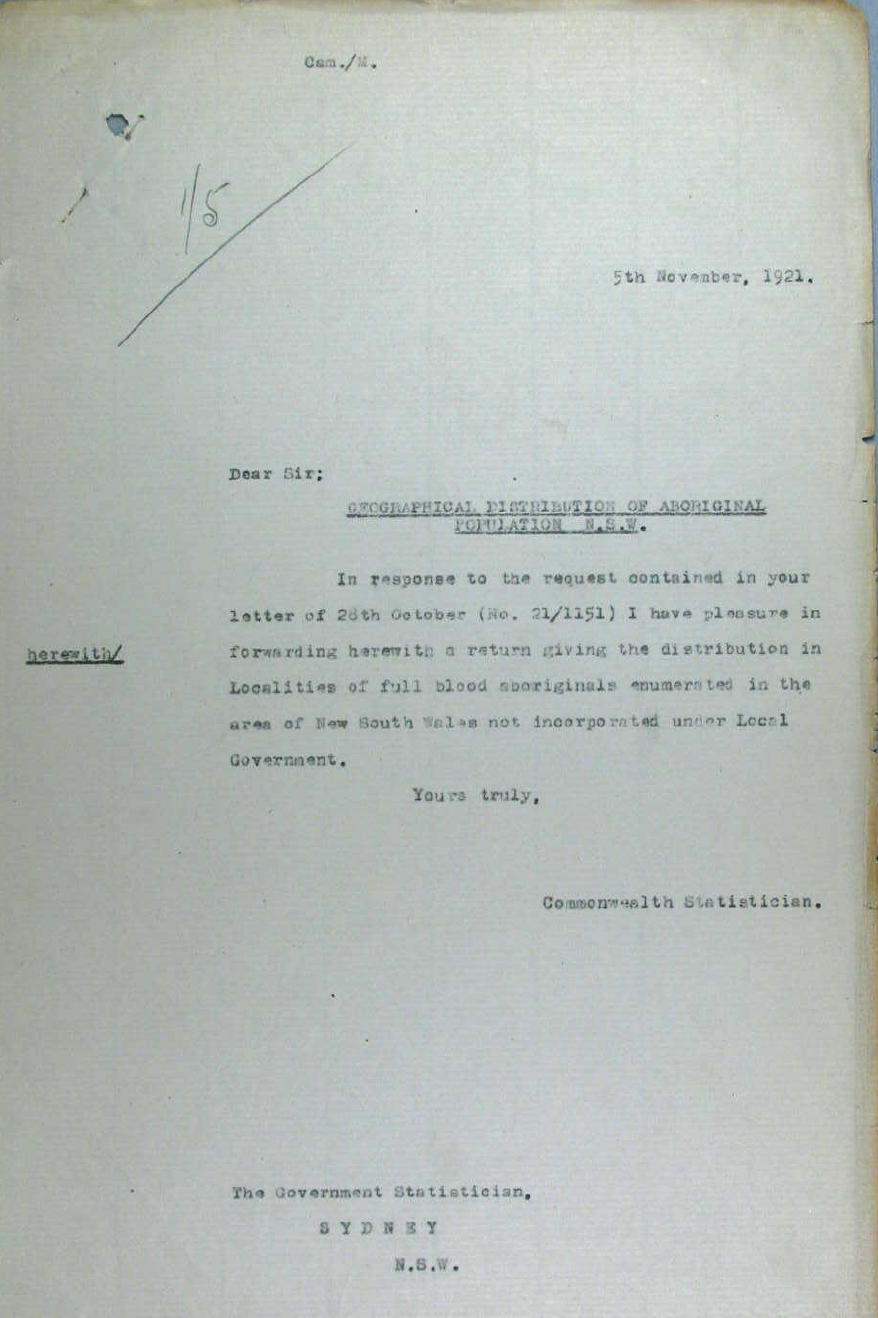
Figure 11B - 1921 Correspondence on “Census of Aboriginals” Source: NAA: A9590, 49
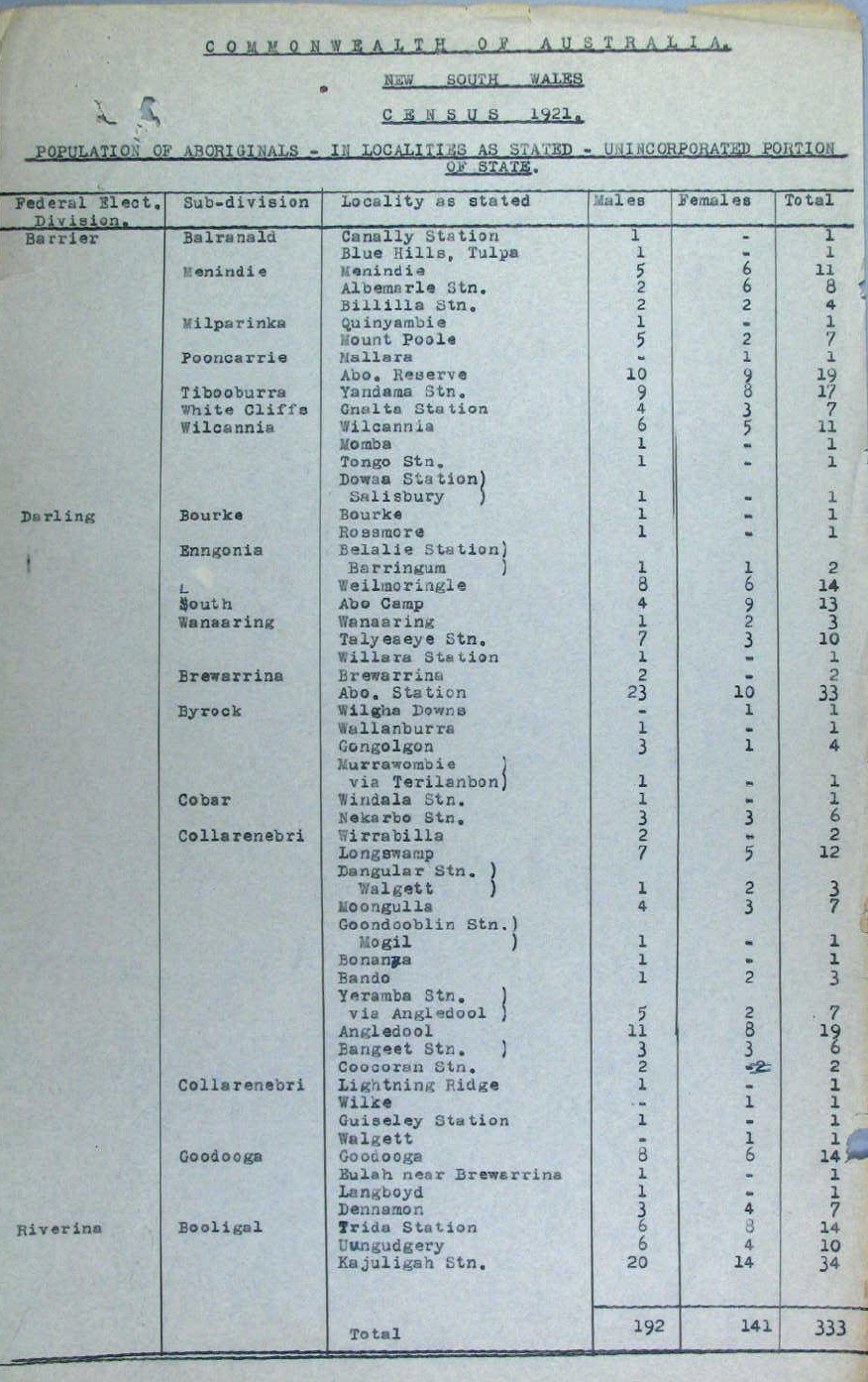
Figure 11C - 1921 Census of Aboriginals in NSW. Source: NAA: A9590, 49
Conclusion
Sadly, it appears that Dr Heiss’ mistaken belief, that Aboriginal people were regarded so lowly that they were not counted in the census, has cursed her political outlook. It has thus created a sense of bitterness and regret in much of her writing on this topic.
She is blind to the incontrovertible fact that she and her ancestors were counted - they were valued and society was brought ‘to account’ for their existence and welfare. The result is that she is the very successful child of Empire, of the British colonisation and Australian assimilation that made her a modern woman writer, free and affluent; a class of person that never appeared or was counted once in the 50,000 year history of pre-colonial Aboriginal society.
Expressing some gratitude, even if it is in the ‘coloniser’s tongue’, seems to be the least Dr Heiss could do for her fellow Australians and their society, they who created these opportunities for her.
References:
Ref. 1 - Pat Stretton and Christine Finnimore, ‘Black fellow citizens: Aborigines and the commonwealth franchise,’ (1993) 25(101) Australian historical studies 521, 534, cited in Stuart Wood AM, KC, The 1967 Referendum: 5 Myths ], 27 Aug 2023, Melbourne The 33rd Conference of The Samuel Griffith Society.
Ref. 2 - Linda Burney, ‘Maiden Speech’ (Speech, House of Representatives, 31 August 2016), cited in Stuart Wood AM, KC, The 1967 Referendum: 5 Myths ], 27 Aug 2023, Melbourne The 33rd Conference of The Samuel Griffith Society.
Ref. 3 - Wood, S., AM, KC, The 1967 Referendum: 5 Myths ], 27 Aug 2023, Melbourne The 33rd Conference of The Samuel Griffith Society.
Ref 4 - Heiss, A., am I black enough for you? - 10 years on , Vintage Books, 2022
Further Reading
2. Counting in Australia was a British Social Construct
- Aboriginal Societies and ‘The Approximate Number Sense’ - and Why They Couldn’t Count
For 50,000 years Aboriginal People were uncounted. No one, not even the Aborigines themselves, enumerated the tribal populations of people living in pre-colonial Australia.
Politically, this begs the question, “Why do activist-minded Aboriginal people, such as Dr Anita Heiss, and their white-allies constantly push the trope that, ‘In 1967 we were counted ‘ when in fact, for 50,000 years, they couldn’t be bothered to count themselves”?
Why are modern Australians made to feel guilty for the false claim that between 1901 and 1967 Aboriginal people were not counted?
The reason that Aboriginal people did not count their population numbers prior to colonisation was that they had no need to. As humans, they had all the intellect necessary to learn how to count, but within Aboriginal daily life and society there were no evolutionary, tribal or societal advantages in having a counting system any more complex than, “one, two, three , (and maybe four) and then, many.”
A description of ‘counting’ within simpler, tribal societies is given by Michael Brooks in his book, The Art of More:
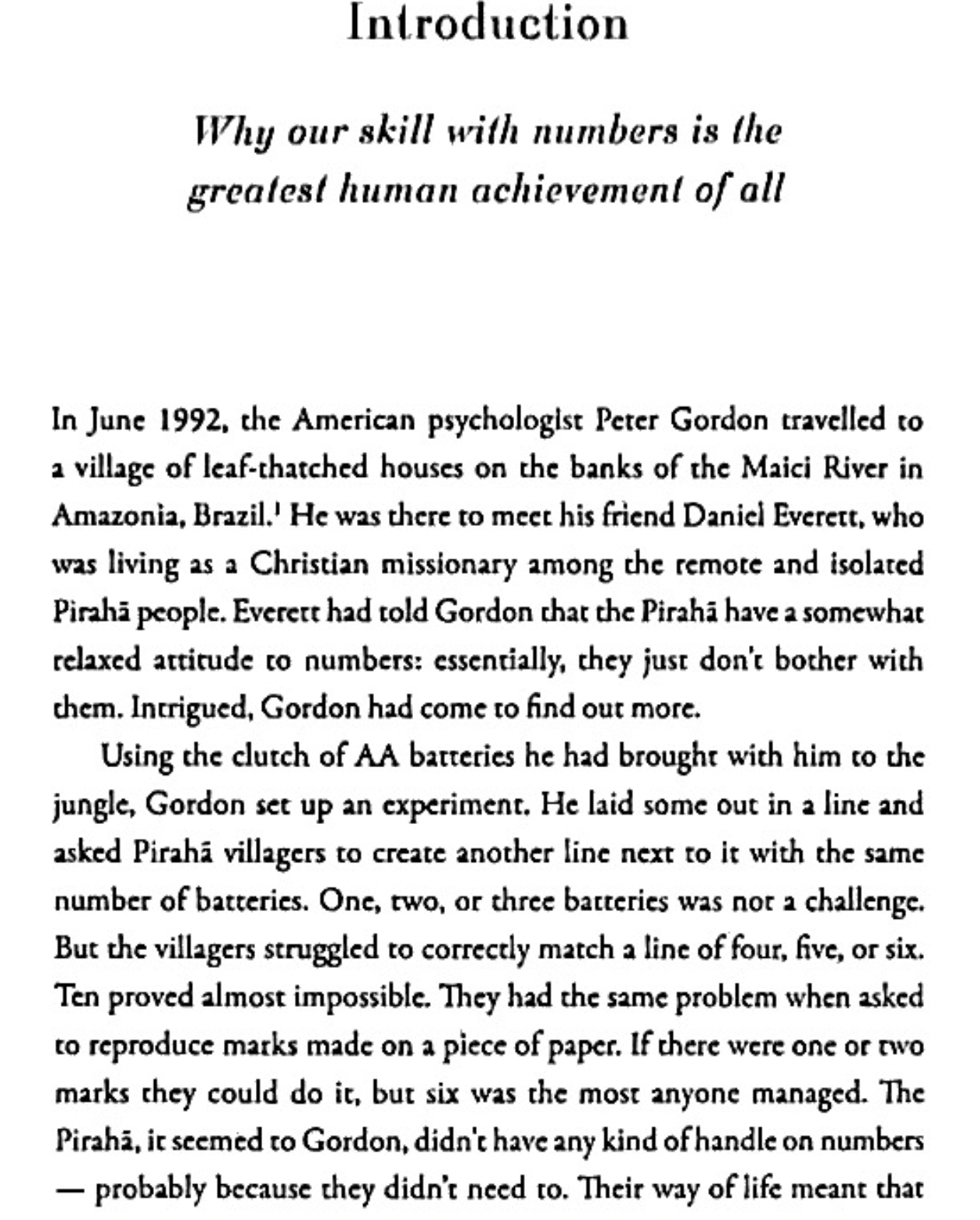
Figure 12A - Extract on the cultural basis for Counting. Source: Michael Brooks, The Art of More, 2012, p1
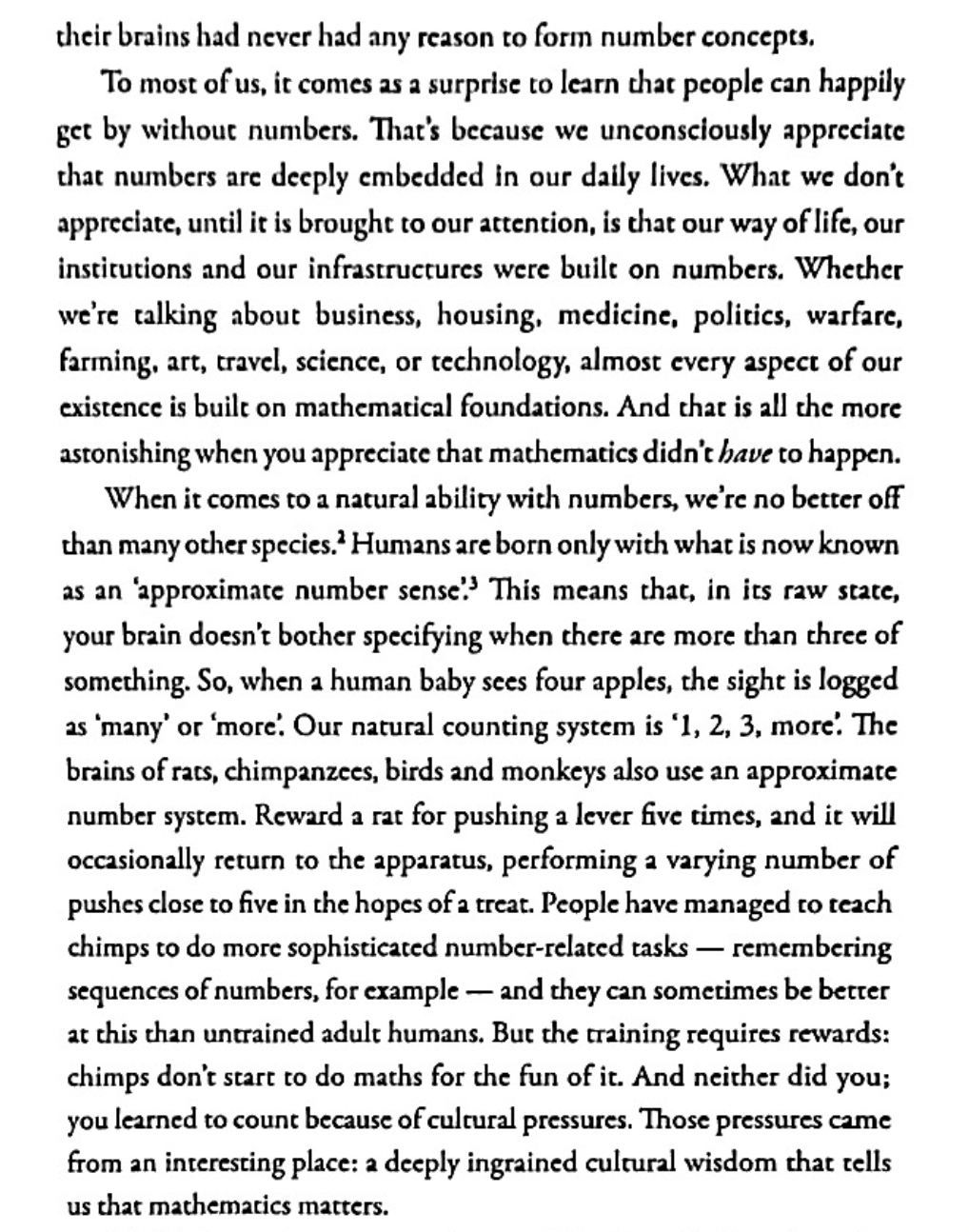
Figure 12B - Extract on the cultural basis for Counting. Source: Michael Brooks, The Art of More, 2012, p2
None of the above is to suggest that, as individuals, Aboriginal people were less intelligent than the British in 1788. Rather, the lack of ability of Aboriginal societies to ‘count’ was because it wasn’t required to survive and prosper in their world of hunting and gathering. Who cares if anyone caught 3 or 8 or 20 fish, if they had no desire to preserve, trade or sell the excess catch. As long as the family was fed with the number of fish they caught, the ‘count’ was immaterial (Figure 13).
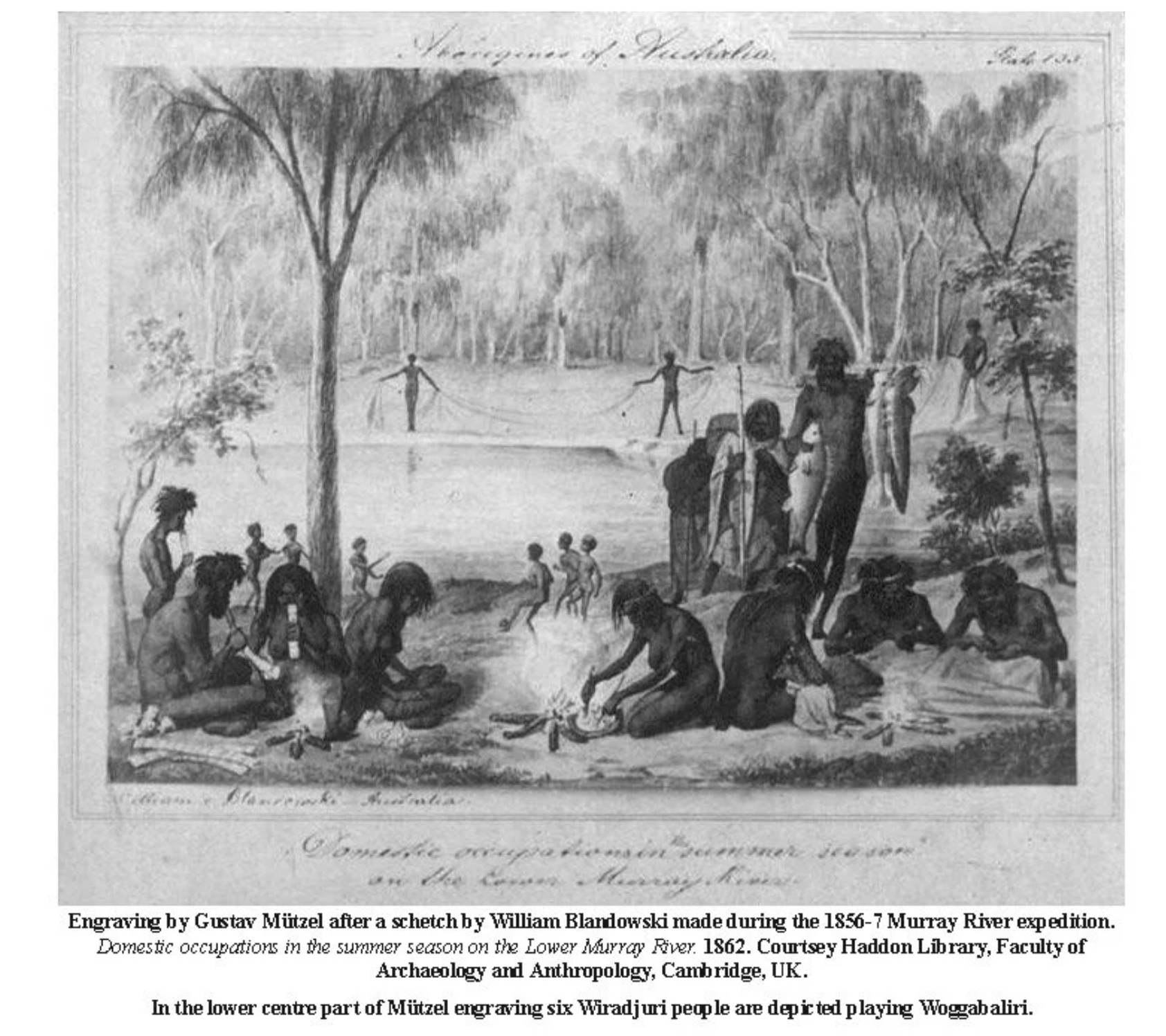
Figure 13 - Stylised picture of daily Aboriginal life on the Murray River. Source: Blogpost
2.1 - The First Official ‘Count’ of Australian Aborigines in 50,000 Years of History
The first ever reckoning of a population of Aboriginal people was recorded on 10 July 1788 in a despatch from NSW Governor Phillip to Lord Stanley in London. Phillip estimated that in the neighbourhood of the settlement at Sydney Cove there were ‘fifteen hundred’ natives (Figure 14B).
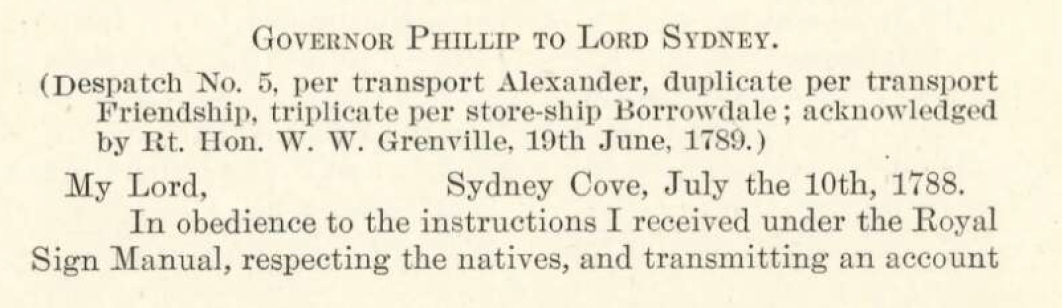
Figures 14A - Source: HRA, SI, Vol I, 10 July 1788, p64-5
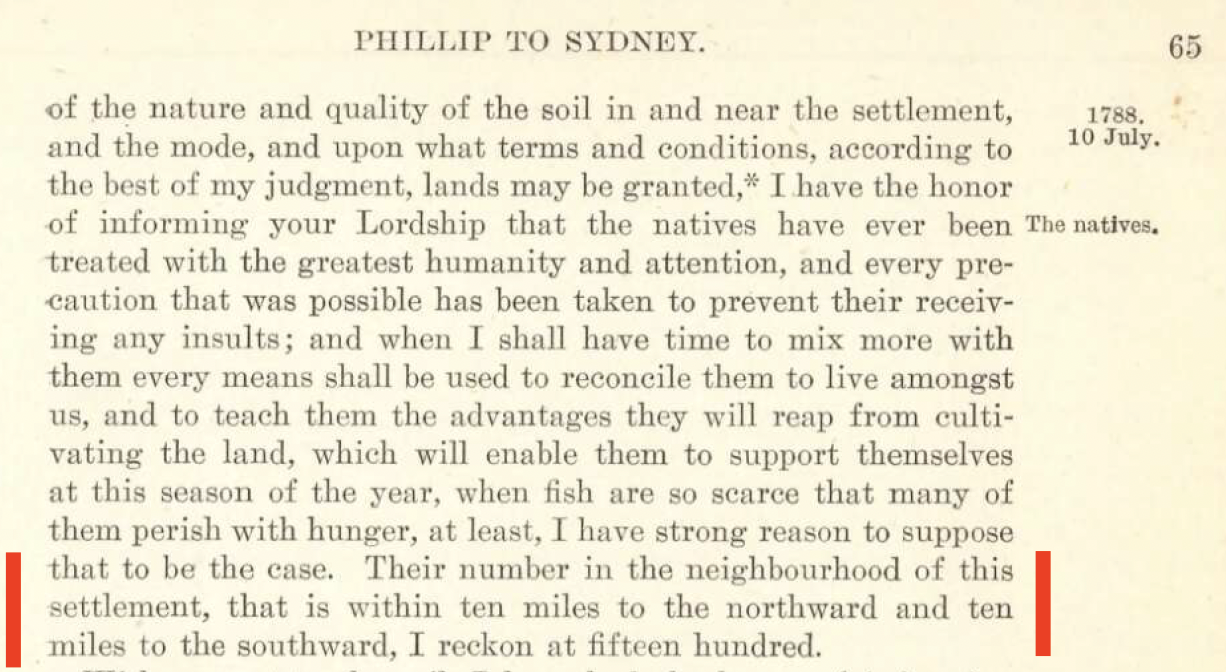
Figure 14B - Source: HRA, SI, Vol I, 10 July 1788, p64-5
One of the saddest aspects of the political beliefs of activists such as Dr Heiss is that they fail to either recognise or, if they do, appreciate and show gratitude for, the modern social constructs such as counting and mathematics, English language and Common Law, and democracy that are all a product of Australia’s colonisation.
Some might think that the observations by the early colonists and missionaries that no Aboriginal tribes appeared to have had words for “please” or “thankyou” is therefore not surprising.
2.2 - Dr Anita Heiss and The Counted Generations
Dr Heiss’ ancestors, the Wlliams and Tallance families lived on various Aboriginal stations in NSW, including Brungle. The Aborigines Protection Board (APB) undertook an annual census of residents at Brungle and published these in the APB Annual Reports (Figure 15).
Thus, Dr Heiss’ claim that ‘we weren’t counted’ would not have applied to her own family members living on the Brungle Station.
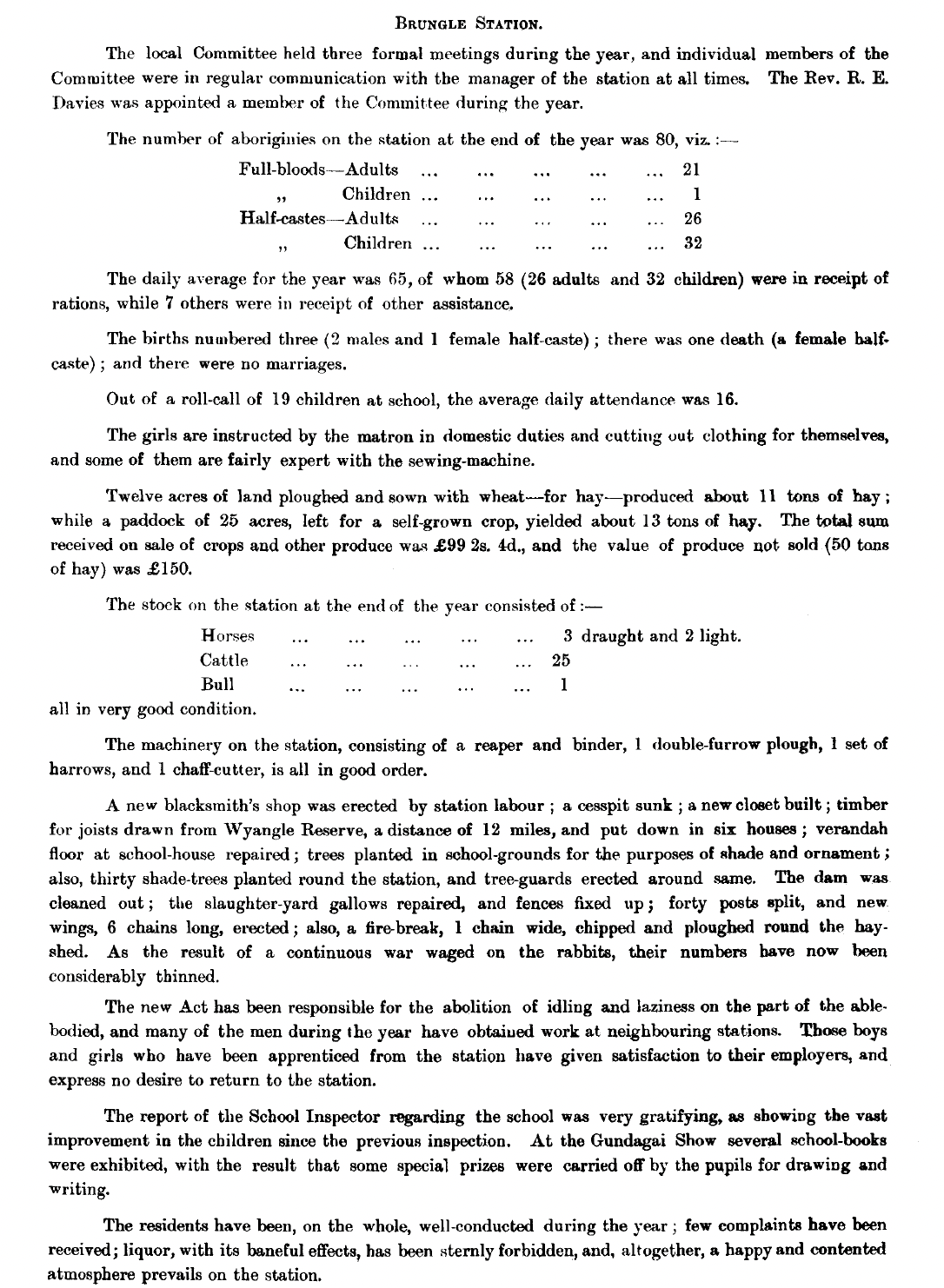
Figure 15 - Dr Heiss’ Aboriginal ancestors who lived on the Brungle Aboriginal station were counted, along with their possessions, incessantly. A typicla report is this one from the NSW Aborigines Protection Board Report of 1911. Source
2.3 - Counting Does Matter
The British social constructs of measuring, counting and recording, and then deciding what steps and resources are needed to improve the lives and status of Aboriginal people has worked brilliantly in NSW.
Dr Anita Heiss’ ancestors, the Williams and Tallances, who lived on Brungle Aboriginal Station, were the direct beneficiaries of this process. By our standards of today life was tough for Heiss’ ancestors in 1898 (See Figure 16,) but conditions appeared to be improving by the 1920s (See Figure 17).
By 1937, only forty years after the first image of Brungle, things were definitely materially better for the whole community (See Figure 18).
Measuring, counting and the application of mathematical productivity had a lot to do with this. These were concepts beyond the comprehension of pre-colonial Aboriginal Australia, which was perhaps a contributing factor as to why archaeology suggests that their material life barely improved over millennia.
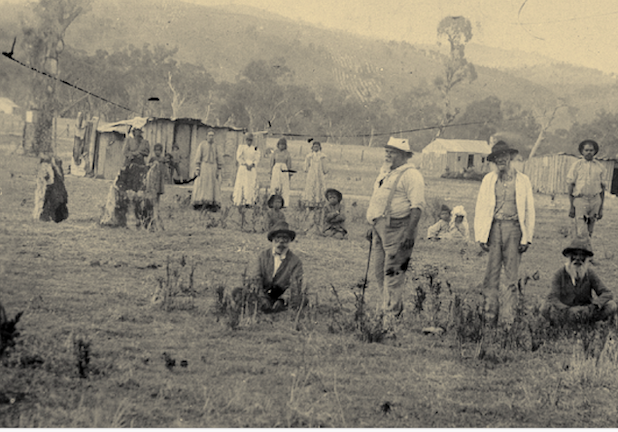
Figure 16 - Residents at the Aboriginal Station, Brungle 1898. Source: AP112/E77812, Australian Museum Archives
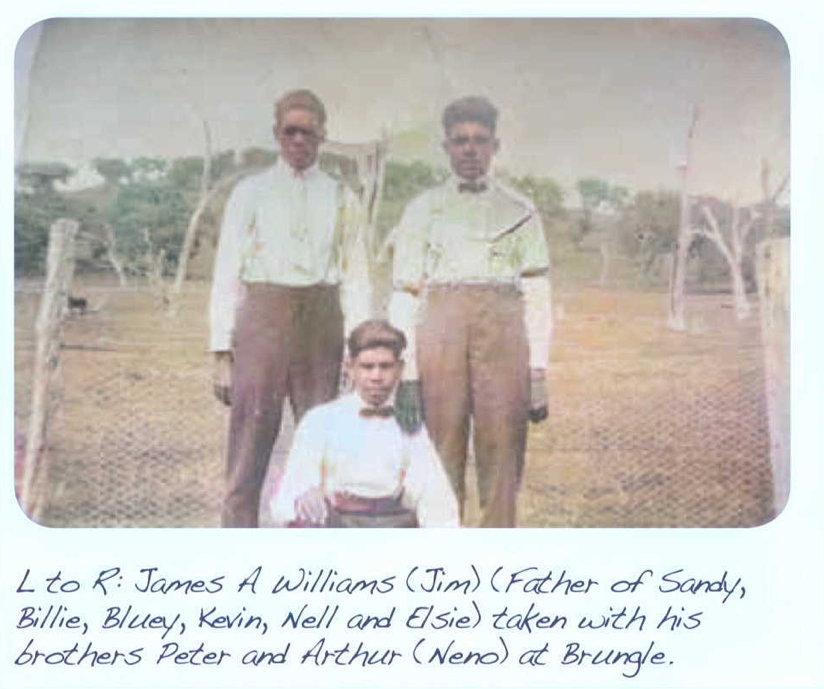
Figure 17 - Said to be a photograph of Dr Heiss’ grandfather James A Williams (Jim) (Left) - Father of Sandy, Billie, Bluey, Kevin, Nell and Elsie [Anita’s mother] taken with his brothers Peter and Arthur (Neno) at Brungle, circa 1920s? Source: Ancestry user Rebecca Symonds originally shared this on 19 Jul 2025
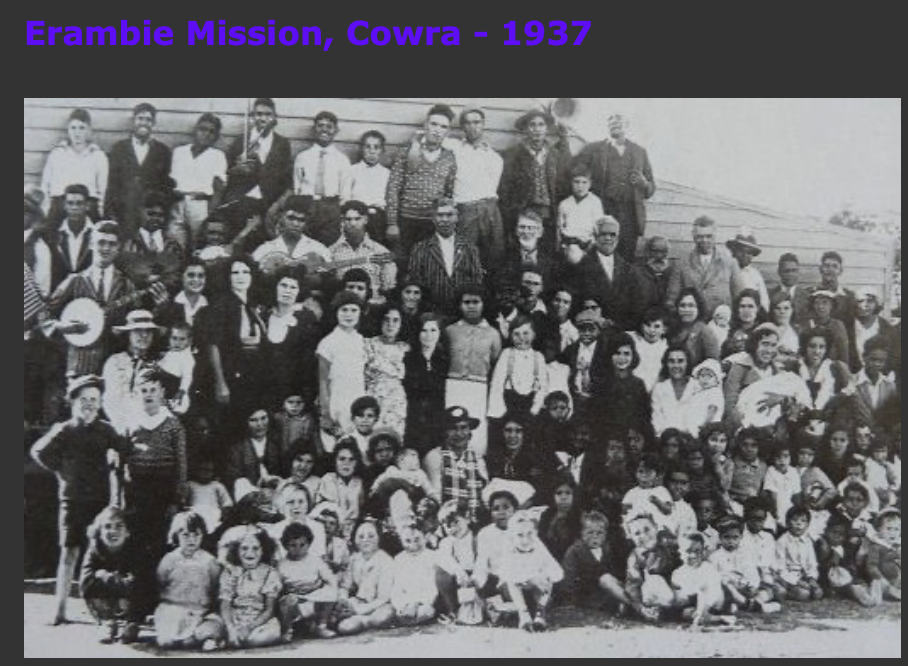
Figure 18 - Members of the Erambie Aboriginal reserve in Cowra in 1937, the birth place and birth year of Mrs Elsie Heiss (nee Williams), Anita’s mother . Clearly the health, wealth, vibrancy and opportunity in a typical Aboriginal reserve community has improved dramatically compared to a typical photograph from 40 years earlier (Figure 10). Source
By 2010 Amy Tallance’s granddaughter, Dr Anita Heiss, was an expert at counting: earning and counting her income, filling in tax-returns, applying for literary grants, using a credit card, booking and buying air-tickets and hotel rooms, and hiring a car in Paris, as her social media pages confirm:
THE AUSTRALIAN EMBASSY: I am grateful for the Australian Ambassador to France, David Ritchie. A man with a fab sense of humour, David hosted a NAIDOC event in his residence where I addressed the intimate crowd on how Aboriginal writers and writing closes the gap in literacy and ignorance. It was a memorable evening as I spoke with the Eiffel Tower as a backdrop. Stunning, as you can imagine!
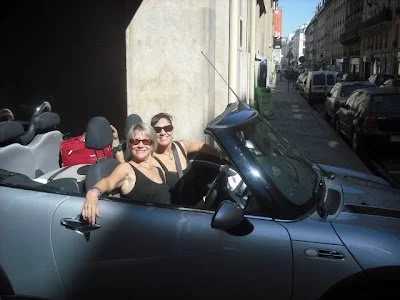
Figure 19 - Dr Anita Heiss, “ I had a whirlwind four days in Paris celebrating NAIDOC Week and researching a travel story for Women’s Health magazine. Sue got us safely out of the city and onto the motorway in her gorgeous mini-coupe (see pic above)… Navigating a right-hand drive on the right side of the road was a novelty and challenge at times. But we arrived in Montcuq in one peace and on time to watch the World Cup final!” Source [July 7 - 11, 2010]
3 - The Restricted Citizenship Rights of Some Aboriginal People.
To be fair to Aboriginal activists, it is not just they who misunderstand the historical voting status of the Aborigines'; even classical liberal economists of the stature of the late Wolfgang Kasper, a frequent writer for Quadrant, could be wrong:
When I came to Australia, it took years before I met an Aborigine. I was shocked to learn how long there had been negative discrimination against Aborigines, for example that they had been denied the right to vote at federal elections before 1967.
- Wolfgang Kasper, Quadrant, Jan-Feb 2015, p45
Depending on the individual state legislation, some Aboriginal people did have their citizenship rights curtailed, unfairly in our eyes today, because under state legislation they may have been considered wards of the state, or were in receipt of regular state aid. In NSW for example, this disenfranchisement arose because:
From 1858 to 1902, every person in NSW who was ‘in the receipt of aid from any charitable institution’ was disqualified from voting (DOC1844), (DOC1845), (DOC1846).
From 1902, the Parliamentary Electorates and Elections Act 1902 (NSW) (DOC2033) allowed people in receipt of charitable aid to vote, but only if that aid was for treatment for an accident or disease at a hospital.
- Source: TowardsTruth Legal website and links to DOC’s
These laws impacted some Aboriginal people because they lived on stations or reserves under the direction of the Aborigines Protection Board. As a result, they were frequently considered to be in receipt of charitable aid and thus were removed from the state electoral roll. This was a matter of public concern and debate in the NSW Parliament (Figure 20).
This put their continuance on the commonwealth electoral roll in jeopardy because, under the Constitution s 41 Right of electors of States:
No adult person who has or acquires a right to vote at elections for the more numerous House of the Parliament of a State shall, while the right continues, be prevented by any law of the Commonwealth from voting at elections for either House of the Parliament of the Commonwealth.
If an Aborigine, or any person for that matter, who was struck off a state’s electoral roll, then they would appear to lose their ability under s 41 of the Constitution to maintain their registration on the Commonwealth electoral roll.
This policy was not ‘racist’ in the sense that it was restrictively applied to only Aborigines - it had applied at that time to anyone in receipt of state aid and to anyone in prison no matter what their race (In 2007, in Roach v Electoral Commissioner the High Court recognised for the first time that Australia’s Constitution protected the right to vote. In doing so, it struck down a law that denied all prisoners the right to vote. The outcome won the right to vote for nearly 10,000 people in prison at the time. - Source).
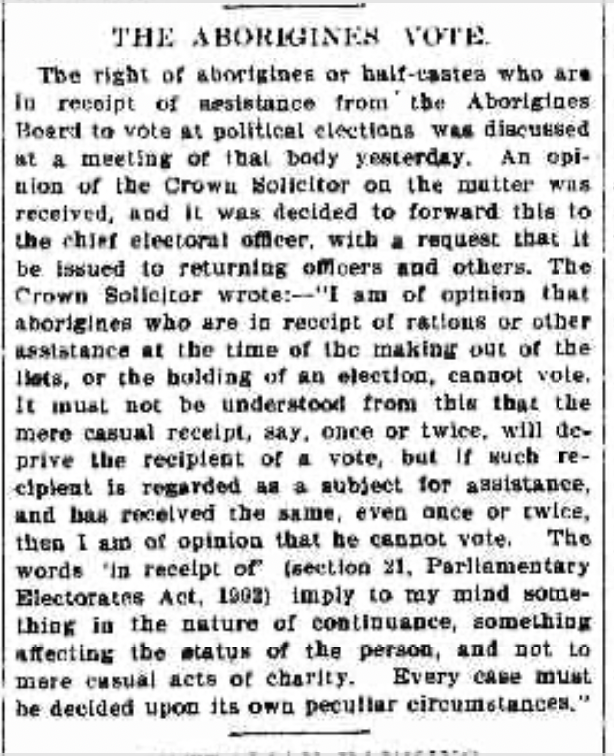
Figure 20 - Aborigines (and indeed any NSW resident) in receipt of regular state aid were deemed not to be able to vote. See also Figure 21 below. Source: The Daily Telegraph, THE ABORIGINES VOTE, Fri 27 Mar 1903 , p 4
With regard to a Federal by-election to be held in the Riverina district of NSW a debate ensued within government departs as to whether certain Aborigines registered on the Commonwealth Electoral Roll at an Aboriginal mission station would be entitled to remain of that roll given that their names had just been ‘struck off the State Electoral Rolls’ prior to the impending Commonwealth election.
The Commonwealth’s Attorney General’s advice (Opinion) details the nuanced legalities of how some Aboriginal voters were treated (Figure 21).
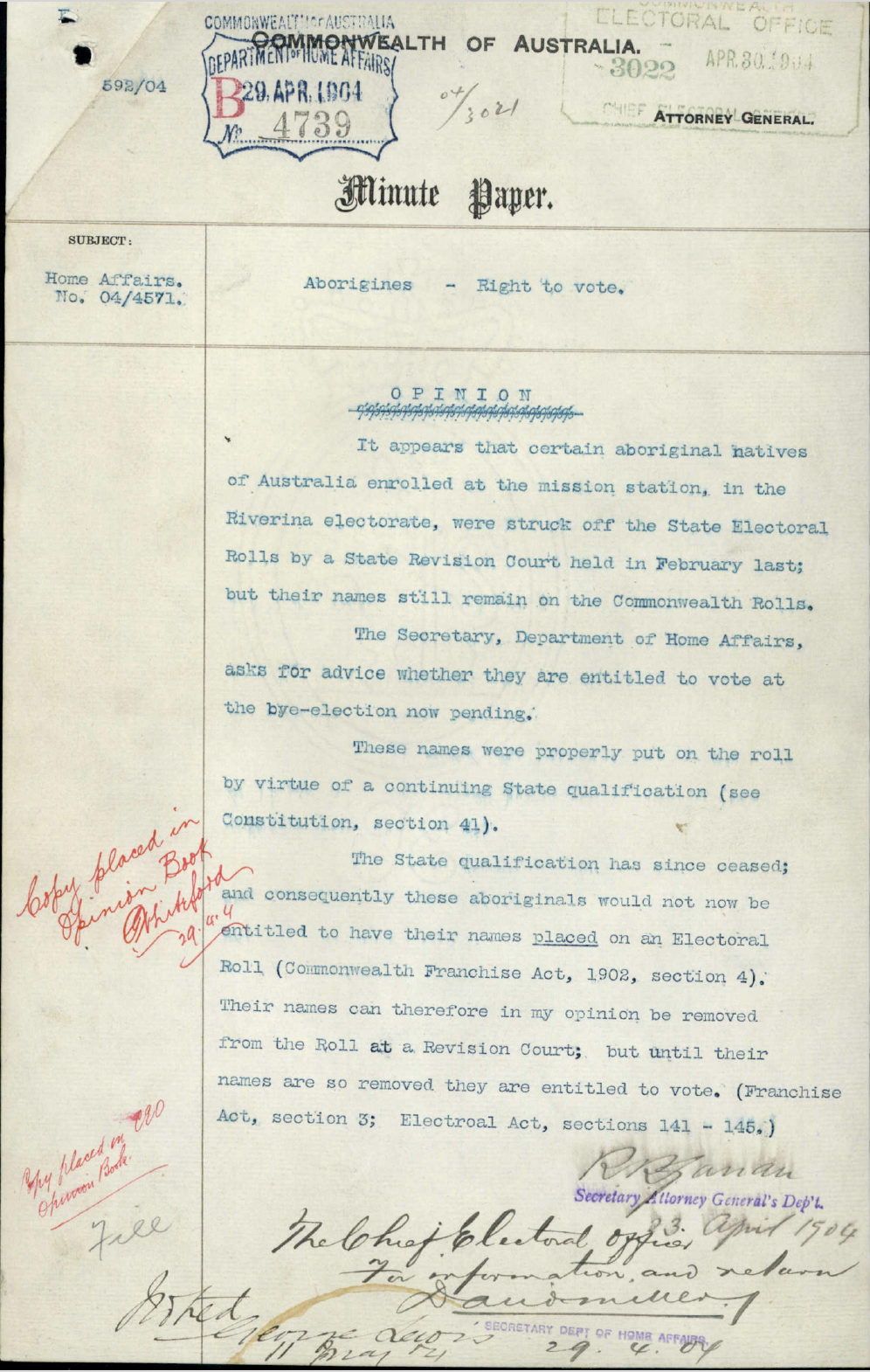
Figure 21 - Opinion from the Commonwealth Attorney General in 1904 advising on the Constitutional requirements covering for Aboriginal voters on State and Commonwealth electoral rolls. Source: NAA A101, B1904/4739
The electoral office confirmed that if the names of particular Aborigines were disqualified to be on the state electoral roll, then they could be removed from the Commonwealth rolls, but until this was actually done, the Aborigines could keep voting federally (Figure 22).
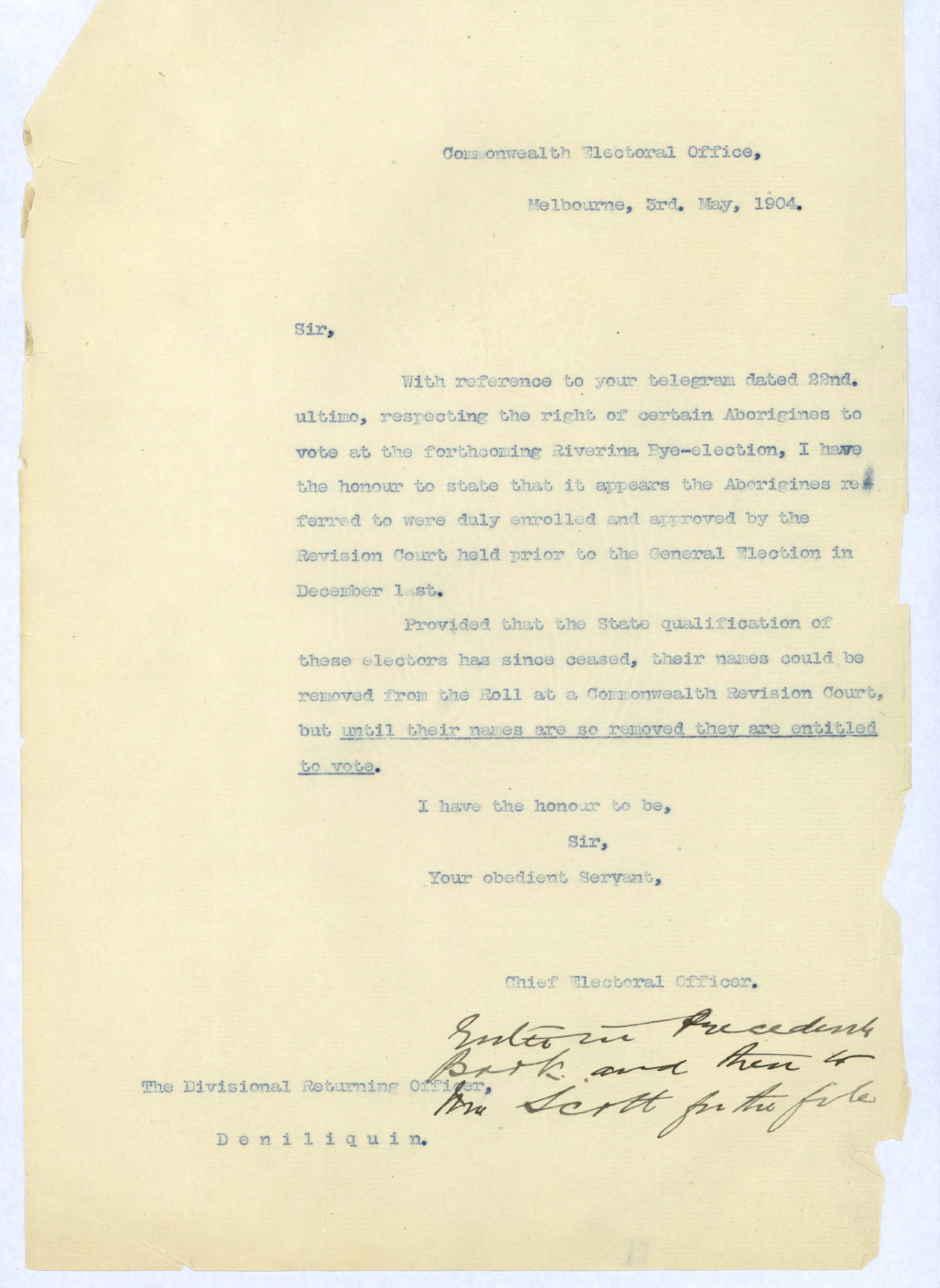
Figure 22 - Source: NAA A101, B1904/4739
3.1 - Definitions of Aborigines
The following archival letters are interesting by providing some context of how Aborigines were preceived and classified in NSW by some public service departments.
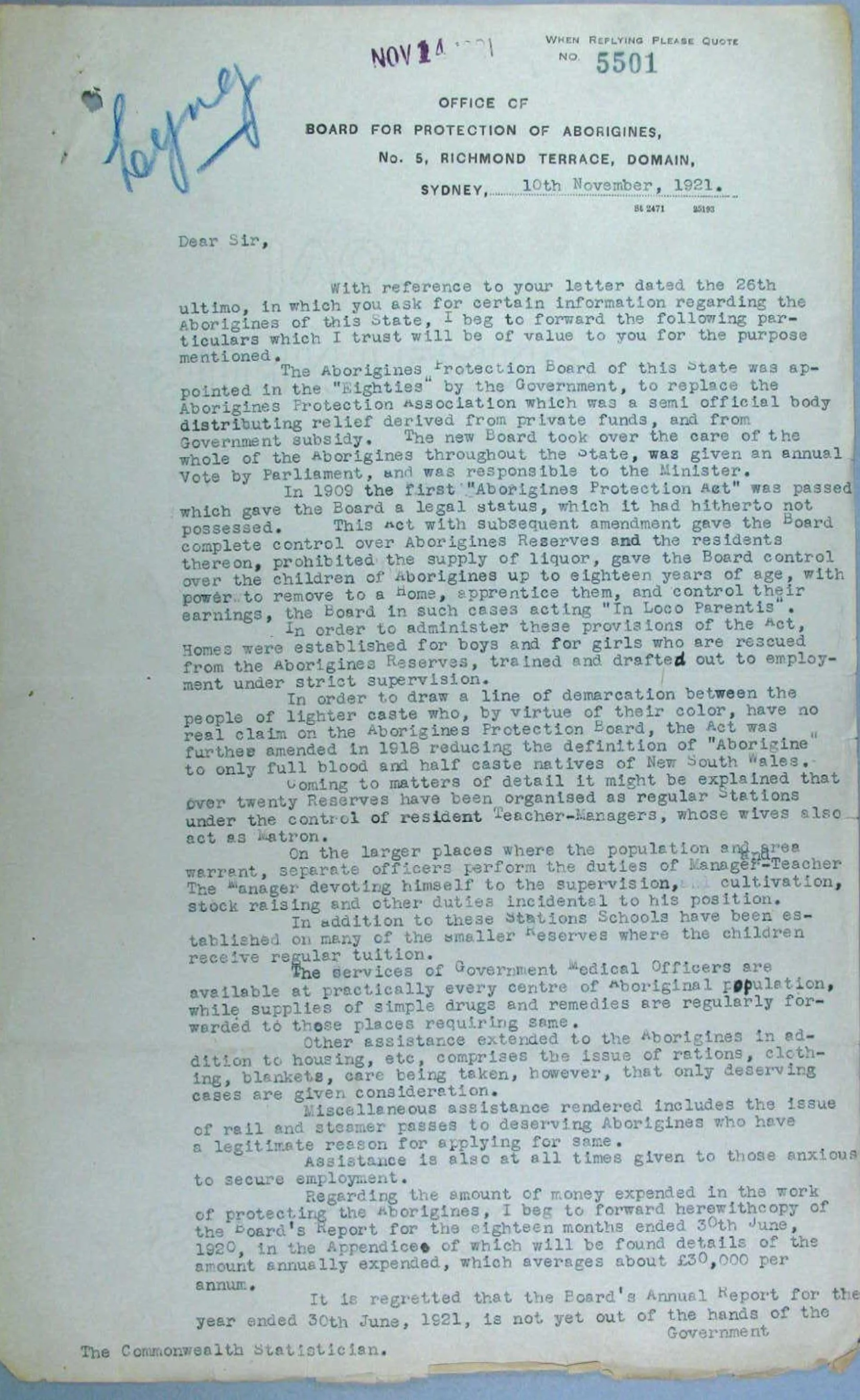
Figure 23 - Source: NAA: A9590, 49, Census of Aboriginals , NSW, 10 Nov 1921, p10-18
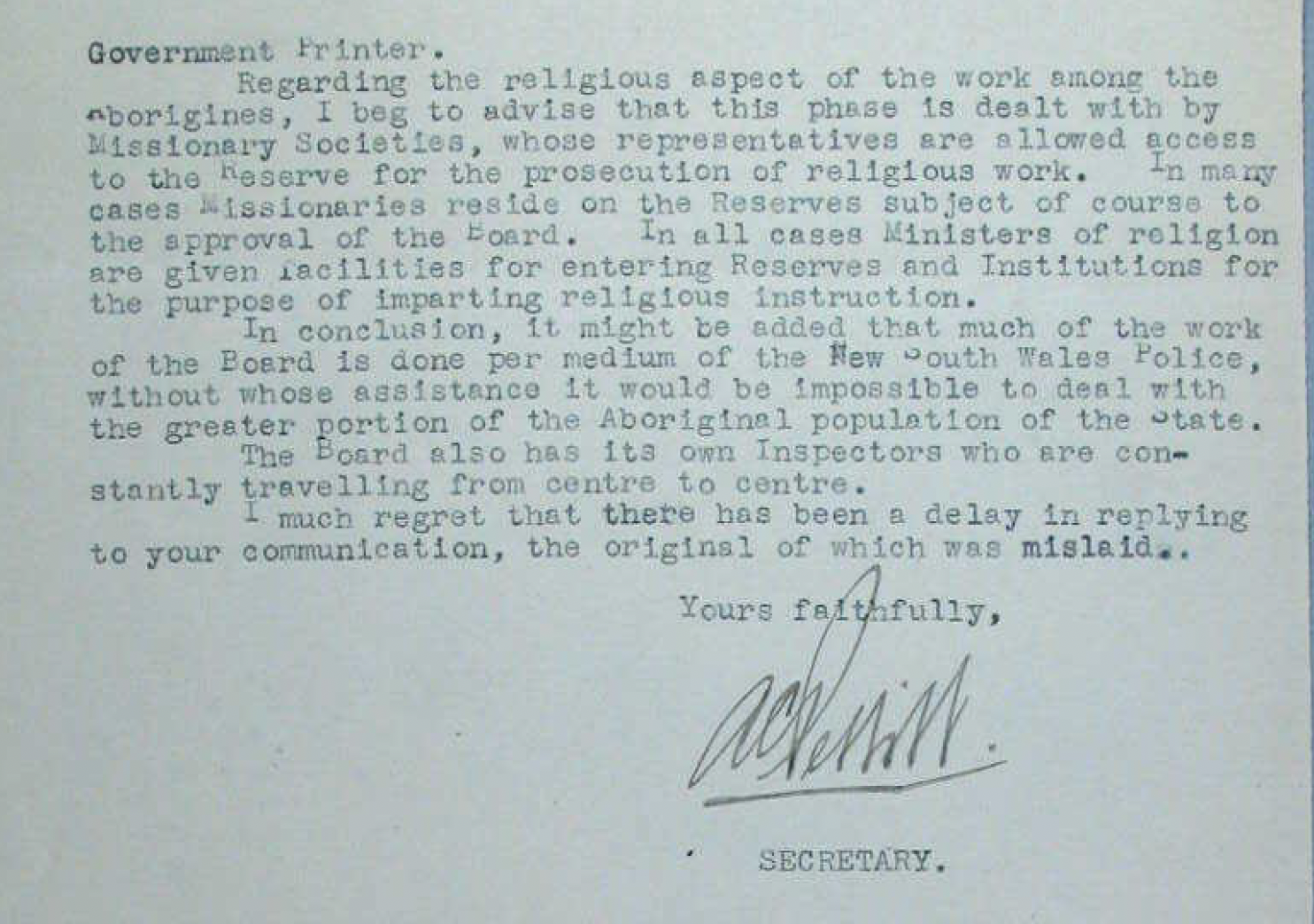
Figure 24 - Source: NAA: A9590, 49, Census of Aboriginals , NSW, 10 Nov 1921, p10-18
3.2 - Extracts for Aboriginal Census Reports 1921
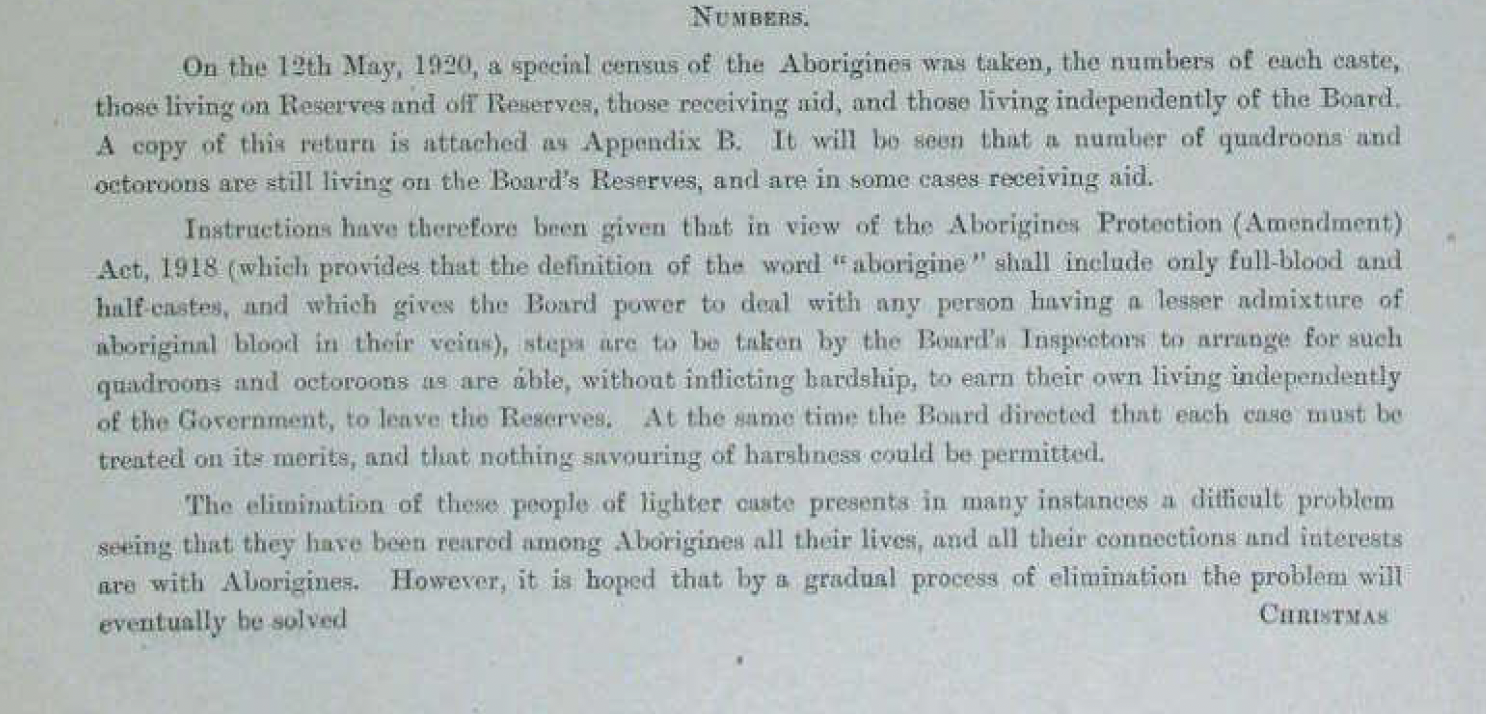
Figure 25 - Source: NAA: A9590, 49, Census of Aboriginals , NSW, 10 Nov 1921, p10-18
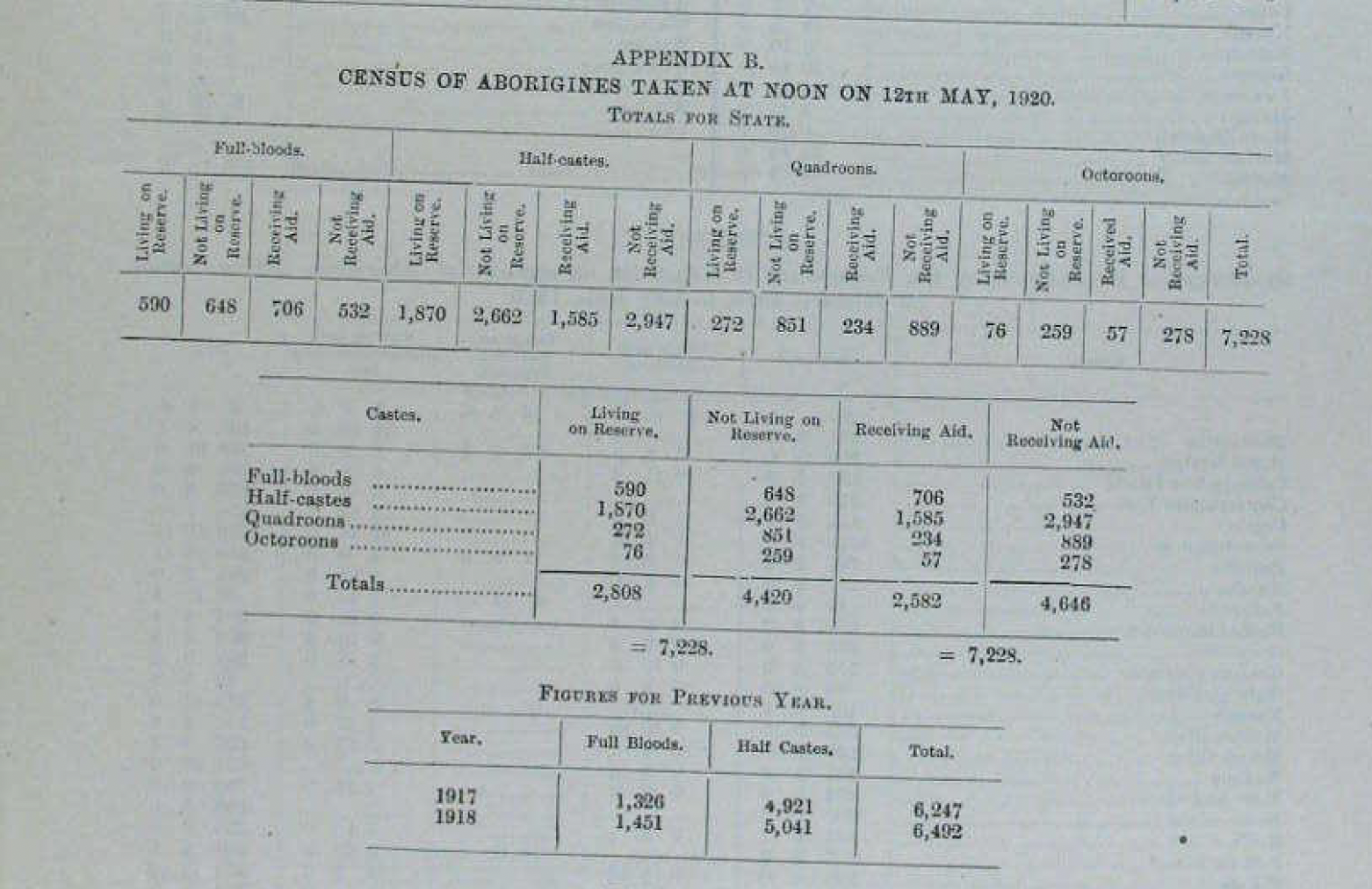
Figure 26 - Source: NAA: A9590, 49, Census of Aboriginals , NSW, 10 Nov 1921, p10-18
4. Closing the Gap? The Life Expectancy of Amy Tallance.
One of the ‘failures’ modern Australia is routinely accused of is the poor record in the so-called ‘Closing the Gap’ initiative. This takes a number of social indicators and compares the outcomes between Aboriginal and mainstream Australians.
One important ‘Closing the Gap’ indicator is life expectancy. Many Aboriginal activists, and their ‘white allies’, claim that Aboriginal people have a significantly lower life expectancy than other Australians. The gap is said to be some 8 to 9 years lower for Aboriginal people compared to other Australians (Source).
So how did Dr Heiss’ ancestors fare?
In Amy Williams’ (nee Tallance) case there was no adverse ‘Gap’. In fact, when Amy was born in c1903 the life expectancy of Australian women in general at birth was 58.8 years. Amy instead lived to 73 years of age, exceeding the life expectancy at birth of her white women cohort by some 14 years (Figure 27).
Doesn’t this suggest that Amy’s life in this regard was positively enhanced by colonisation and assimilation and the British social construct of counting?
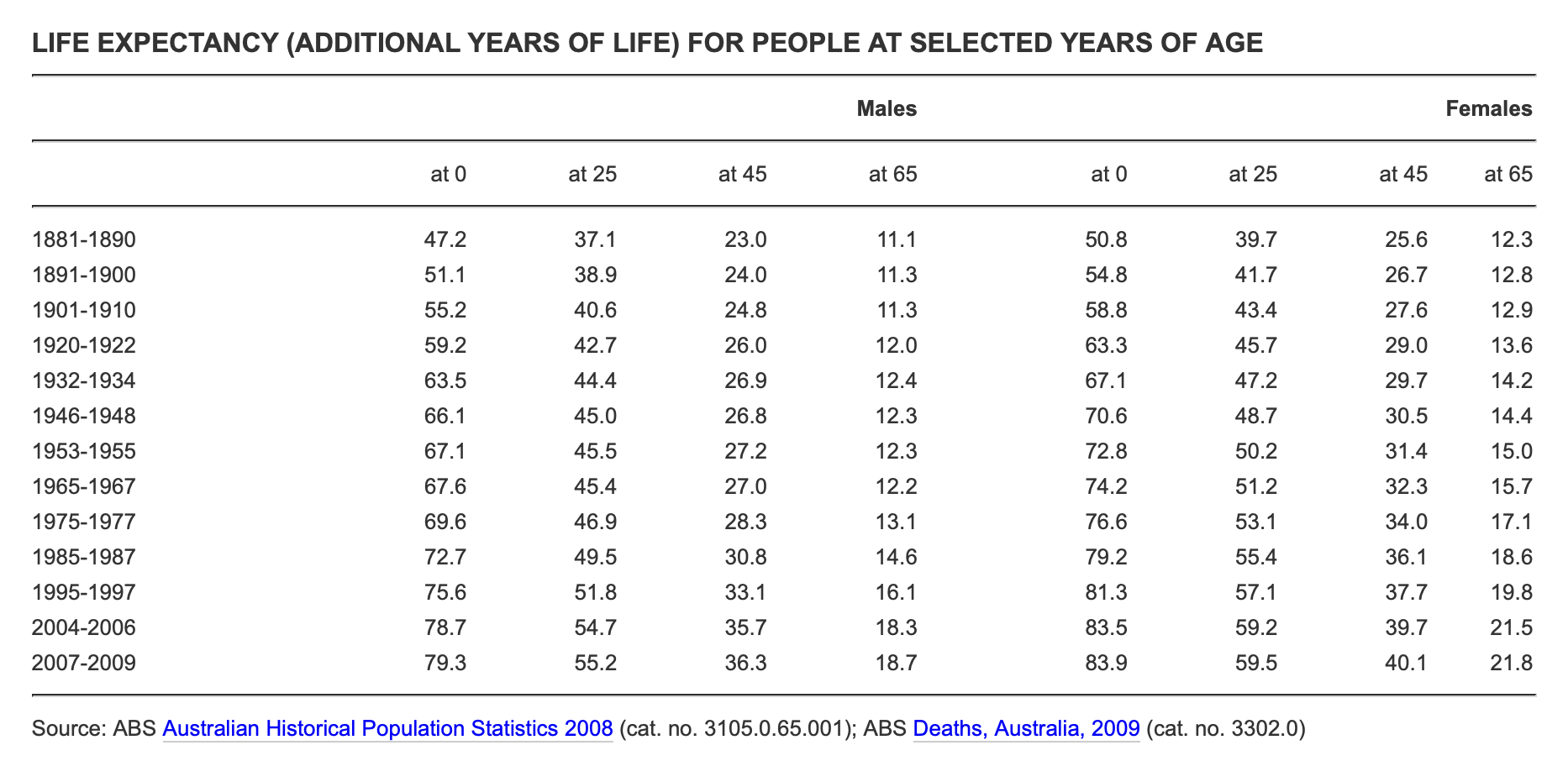
Figure 27 - Historical Life Expectancy Chart for all Australians . Source: ABS