Anita Heiss' Nazi Grandfather - Is this the Ultimate Irony?
Posted 19 August 2026
“You’ve got some of the country’s best legal counsel. Ron Merkel is not going into this case to lose, you can believe that.” I knew then that I had to have faith in the [legal] team … and that victory was always about what I believed was morally right, not simply about winning a fight.’
- Anita Heiss, reminiscing 10 years after her historic court win in Eatock v Bolt [Note 1]
In 2011, Australian writer and commentator Dr Anita Heiss joined the lead applicant, Aboriginal activist Pat Eatock, in taking the Herald and Weekly Times and journalist Andrew Bolt to Federal Court for breaching section 18C of the Racial Discrimination Act.
Bolt had written two newspaper articles in which he called Eatock and Heiss, along with a number of others, ‘white Aborigines’ and implied they were selectively using their Aboriginal ancestry to preferentially access benefits and career opportunities. They were furious and claimed Bolt’s articles were ‘humiliating, offensive and insulting’ and in clear breach of the Act. The women would go on to win this (in)famous case which would become known as Eatock v Bolt 2011.
As Dr Heiss sat in court on Day One of the proceedings, she could hear her counsel Ron Merkel QC, the son of Russian Jewish immigrants himself, pile a succession of ‘Nazi-like’ slurs upon Bolt and the contents of his articles. In front of Justice Bromberg, who was also Jewish, Merkel QC told the court:
Mr Bolt, in his articles, has taken us back to that eugenic approach to aboriginality … [he is ] a man who is living in a mindset frozen in history, frozen in point of time … this kind of thinking [by Bolt] lead to the Nuremberg race laws … the point I am making, is this pure eugenics approach, even in Nazi Germany, accepted some relevance of you being part of a community. It is an extraordinary concept in a time warp to go back to this, how you look and what kind of blood you’ve got … The Holocaust of the 1940s started with words and finished with violence. [Note 2]
On Day 2 of the trial, Bolt was in the witness box protesting against these slurs:
Can I just ... suggest that it has been put to me in the statements handed to you, and in the cross-examination it is implied, that I am a racist, eugenics, the Nazi stuff, when as my articles insist, I am attacking racism. That is my point of view. I have been anti-racist all along. [Note 3]
Bolt elaborated further outside the court, as reported by the ABC:
Newspaper columnist Andrew Bolt was boiling with anger when he entered the witness box on the second day of a racial vilification case, stung by comparisons of his articles with Hitler’s Nazi Germany. The controversial News Ltd commentator is being sued under the Racial Discrimination Act by a group of Aborigines over a series of articles he wrote in 2009 ... Bolt listened on Monday as Ron Merkel, QC, the counsel for the nine Aborigines bringing the class action, said his articles on racial identity took a eugenics approach and echoed the Nuremberg laws of 1935. While Mr Bolt had been warned by Justice Mordecai Bromberg not to use his testimony as a public forum, the journalist vented his anger before his cross-examination today. He said any statement linking him to the Nuremberg laws and the Holocaust “were false and grossly offensive”. “Mr Merkel crossed the line,” Bolt said, adding that he was a vigorous opponent of the eugenics movement. [Note 4]
Dr Heiss would have also listened carefully as her eminent counsel, Ron Merkel QC, read out and give great credence to the affirmed witness statement of his lead client, Pat Eatock. Merkel QC related to the court, on Pat’s behalf:
I am an Aboriginal person with Aboriginal ancestry. My grandmother, Lucy Eatock, was born in Carnarvon Gorge in central Queensland in 1874. This is an Aboriginal birthing place, an Aboriginal women’s place, an Aboriginal commitment place. She was one of the Kirri people. My grandmother’s mother was an Aboriginal woman called Kitty. My grandmother’s husband, my grandfather, was an Aboriginal man, Bill Eatock. They married in 1894. He looked very Aboriginal. I have seen a photograph of Bill; he had a very black face and a long white beard. Bill was from the Woga Woga Waka Waka people from the Queensland coast from Fraser Island to Moreton Bay.
The first great irony of the Eatock v Bolt court case was that Ron Merkel’s lead applicant turned out to be a ‘fake’.
As detailed in the book, Witness for the Prosecution, Pat Eatock’s witness statement was a series of untruths. Mr Merkel had been duped. Her grandparents were not Aboriginal at all, and thus she herself had no Aboriginal ancestry. Merkel had misled the court by believing, and giving authority to, Eatock’s affirmed witness statement.
In effect, Andrew Bolt was stitched up by Pat Eatock and her high-profile counsel - she really was a ‘white Aborigine’ and essentially of Scottish descent, as Bolt had written in the ‘offending’ articles.
We can now reveal a second great irony about this court case which shows that Bolt was even more ‘stitched up’ than he could ever have imagined.
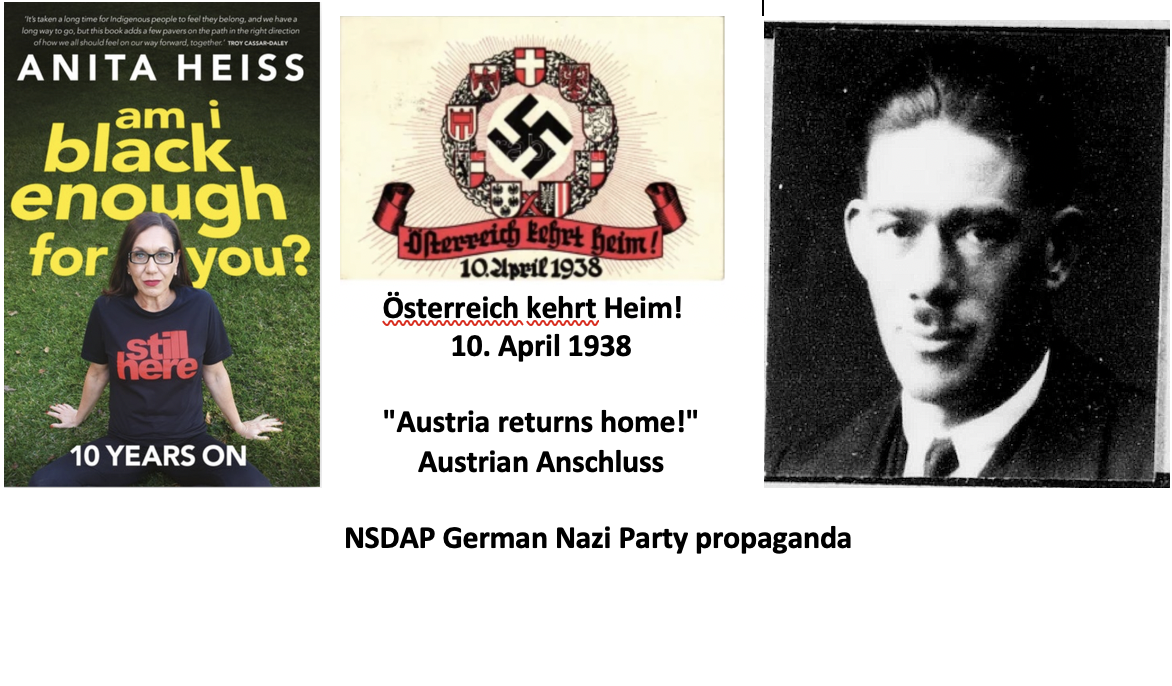
For it now transpires that Dr Anita Heiss, whose counsel, Ron Merkel QC, was whipping up Nazi-inspired slurs against Bolt, herself had an Austrian grandfather who had been an actual card-carrying member of the Nazi party in 1938.
In early 2026, the US Archives released for the first time some 12million records of members of the Nazi party, records that the US forces had discovered in the ruins of Germany at the end of WWII. These records have now been made available to the public via the German newspaper, Die Zeit.
Simply by going to the online Die Zeit website, any member of the public world-wide can now, for instance, search for any records relating to a “Josef Heiss in the Salzburg region of Austria” and find the following record (Figure 1):
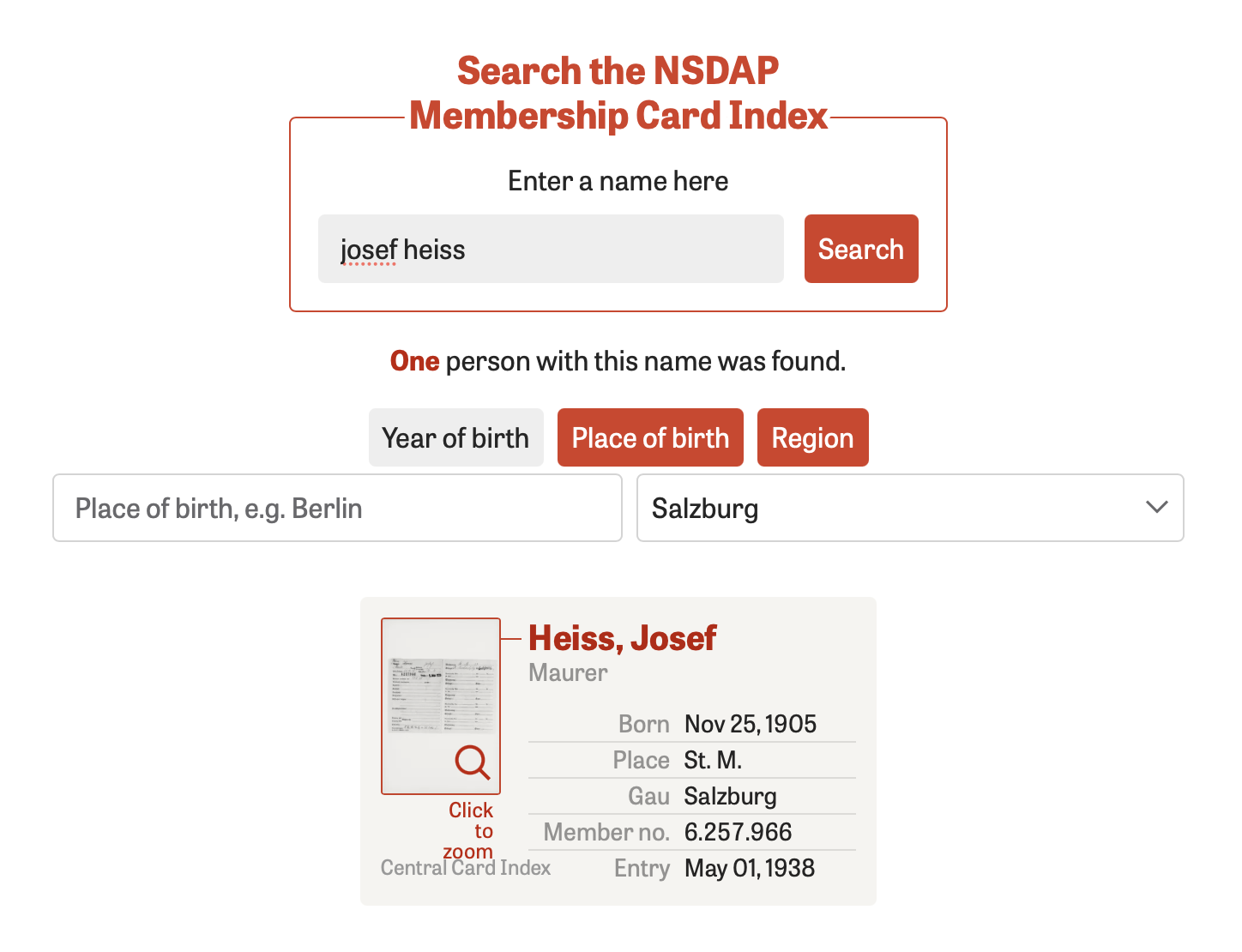
Figure 1 - Screenshot of the Die Zeit Nazi-member records database showing details of a “Josef Heiss” who, on further research, turns out to be Dr Anita Heiss’ paternal grandfather. Open Source: Die Zeit
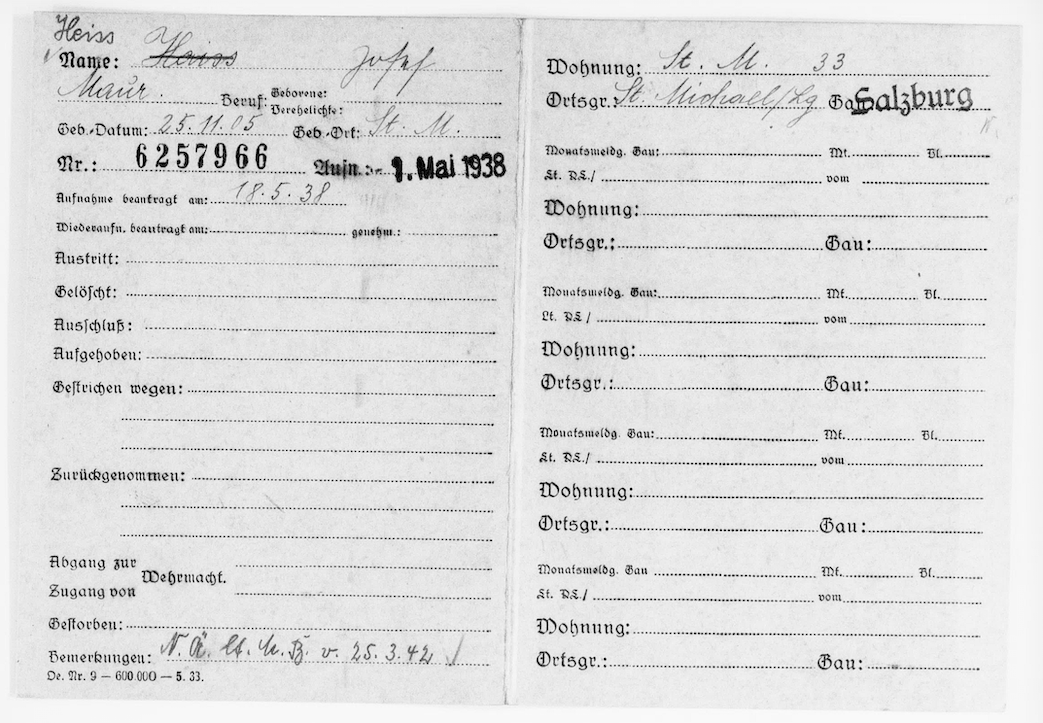
Figure 2 - - Extract of a record for “Josef Heiss” from the Die Zeit Nazi-member records database. It shows page 1 of his NSDAP Membership Card from the Zentralarchiv - i.e. the index card registering his membership at the NSDAP central archive in Munich. On further research this “Josef Heiss” turns out to be Dr Anita Heiss’ paternal grandfather. Open Source: Die Zeit.
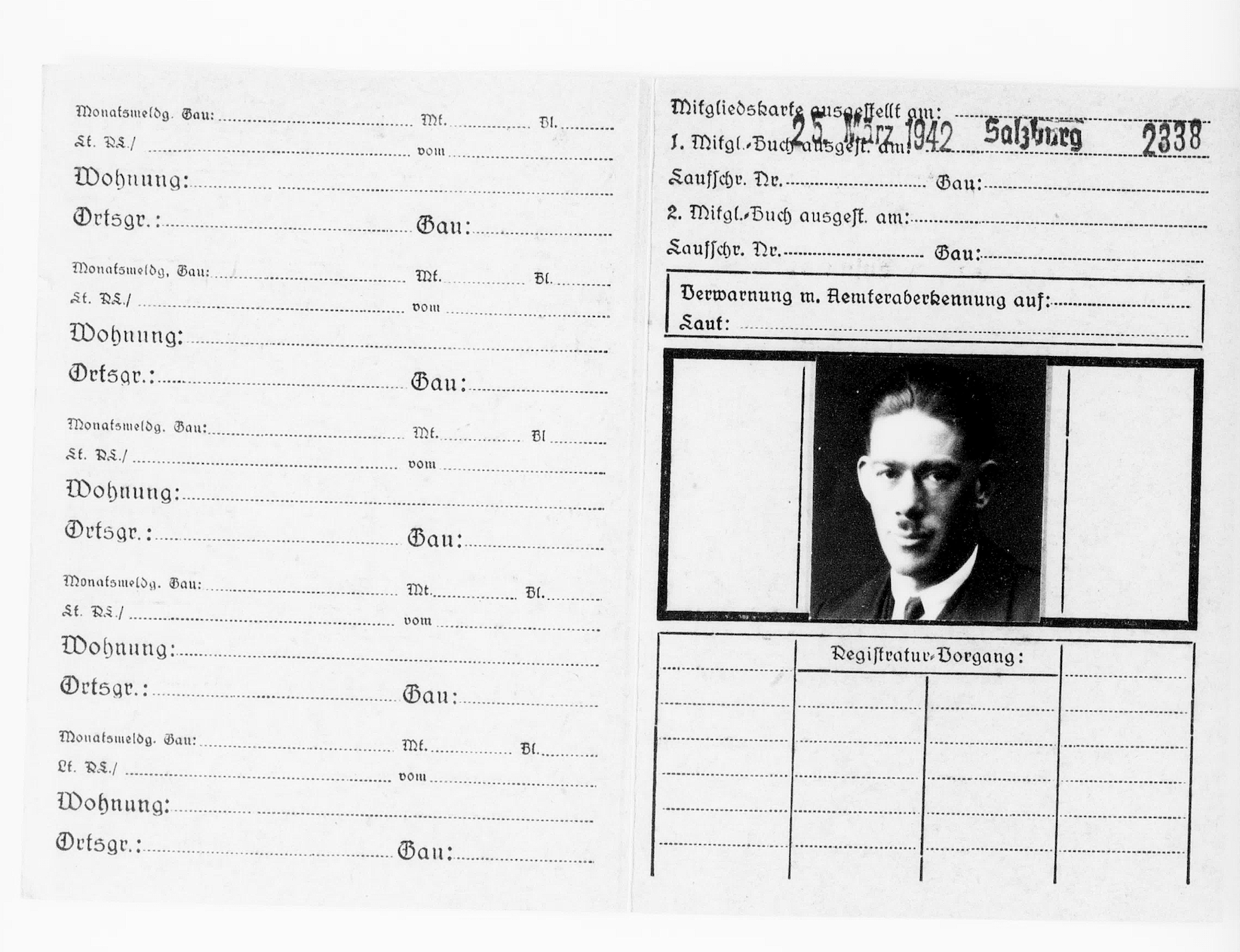
Figure 3 - Extract of a record for “Josef Heiss” from the Die Zeit Nazi-member records database. It shows page 2 of his NSDAP Membership Card from the Zentralarchiv - i.e. the index card registering his membership at the NSDAP central archive in Munich. On further research this “Josef Heiss” turns out to be Dr Anita Heiss’ paternal grandfather. Open Source: Die Zeit.
As detailed below, we believe that this record is for Josef Heiss snr - Dr Anita Heiss’ Austrian, paternal grandfather. It shows he joined the Nazi party only a few months after the Austrian Anschluss of 1938.
Dark Emu Exposed has a German-speaking, genealogical researcher on our team and his translation and analysis of Josef Heiss’ Nazi party card is as follows:
1) The Card is “Josef Heiss’ ” NSDAP Membership Card from the Zentralarchiv - i.e. the index card registering his membership at the NSDAP central archive in Munich. This would have been initially completed without a photograph. [Note: National Socialist German Workers' Party (German: Nationalsozialistische Deutsche Arbeiterpartei, or NSDAP]
2) It appears that the applications were forwarded to a central office in Munich that physically issued the numerical membership number in sequence, so the membership number is a good indication of the date of joining where this is unknown. Because of the time delay, it appears that the date of membership was routinely pre-dated to the start of the month [1 May 1938] in which the application was received [on 18 May 1938]. Hence the oddity that he applied for membership on 18 May 1938 and was accepted on 1 May 1938.
3) None of the ‘Monatsmeldungen’ [monthly reports] are completed, but having checked a variety of cards from the region, it appears that not having any Monatsmeldungen is usual. In fact, these entries do not record attendance at meetings, or the paying of dues, but rather this part of the card (based on other cards examined in the Central Archive) is where misdemeanours, changes in status (marriage, entry to military, etc.) or perhaps international travel would be recorded. The regular dues were collected at the local party offices where a copy of the card was held and a stamp affixed when the membership fee had been paid. Loyal party members would later be issued with a Mitgliederbuch (Membership Book).
4) The card records the issue of Josef's Mitgliederbuch on 25 Mar 1942. This was a small booklet actually carried by the party member. After 1933, this was usually awarded after at least two years of NSDAP membership - often longer - after having completed their “probation”. At that time, the party member would no longer use the basic membership card, but be issued with a membership book in which the stamps for membership would be affixed. His/her photo would also be included in the book as well as the index card at HQ at that time. Notably, the attainment of a Membership book required active effort on behalf of the party member. The ‘Book’ was issued by the Reichsschatzmeister (Reichs-treasurer) of the NSDAP.
5) Josef joined the NSDAP on 18 May 1938, only two months after the Anschluss. The NSDAP had previously been banned in Austria, but following the Berchtesgaden Agreement in February 1938, the ban was officially lifted when German troops entered into Austria on March 12, paving the way for the Anschluss (annexation) proclaimed on March 13.
In summary, it appears that Josef joined the NSDAP early and was possibly more than a ‘casual' member, having applied for, and been granted, his Mitgliederbuch in 1942.
The Evidence Presented that “Josef Heiss the Nazi” is the same person as “Josef Heiss snr”, Dr Anita Heiss’ Austrian grandfather:
1) Dr Heiss, in her book Am I black Enough for You? - 10 years on, tells us that:
Dad [Josef Heiss jnr] was born in 1936 in St Michael, in Lungau region of Salzburg, Austria. The eldest son of Josef and Maria Heiss… [Note 1, p41]
2) This claim by Dr Heiss is corroborated by details from the 1960 marriage certificate of Anita’s parents (Figure 4). The groom, Josef Heiss [jnr] declares he was born in “St Michael, Austria” and his parents were “Josef Heiss [snr]” and “Maria [Heiss nee] Pfeifenberger”. Anita’s parents were actually married on the groom’s birthday - 5th November 1960 - (see Figure 4 with privacy redactions) so his stated age was 23 prior to the wedding but he turned 24 on the day of the wedding, making his year of birth 1936. This information matches Anita’s claim above.
Additionally, this marriage certificate shows that Anita’s grandfather, Josef Heiss snr, was a “bricklayer”.
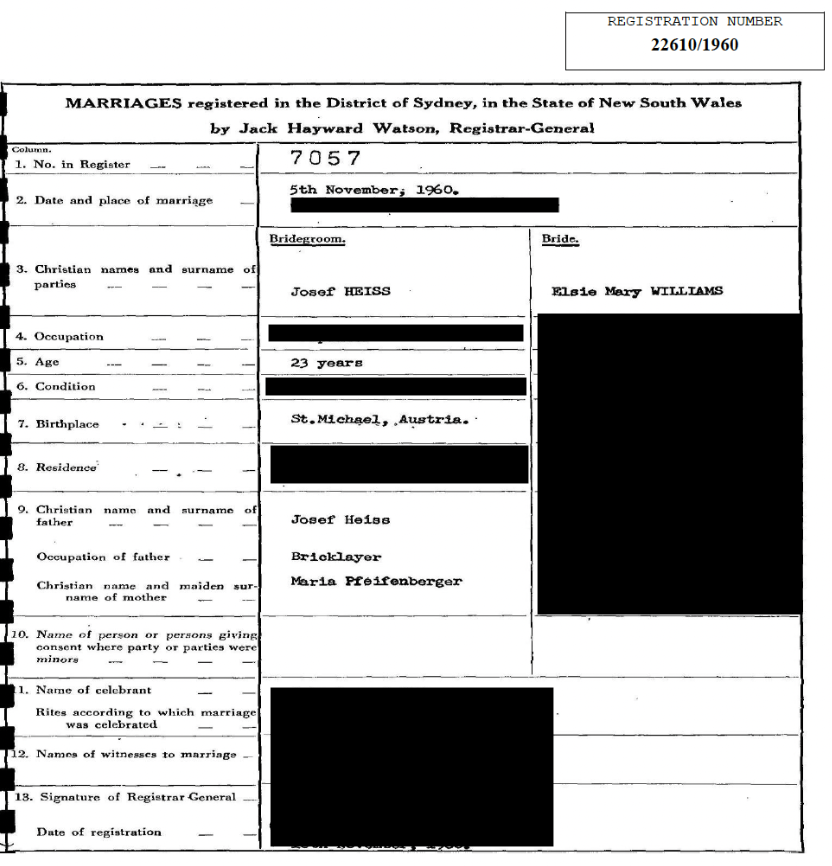
Figure 4 - Extract of the Marriage Certificate for the 1960 wedding of Anita Heiss’ parents, Josef Heiss jnr and Elsie Mary Williams. It lists the groom’s father’s [Anita’s Austrian grandfather’s] details. Non-relevant information has been redacted for privacy. Source with redactions: NSWBDM#22610/1960
3) Dr Heiss’ father’s birthplace and age details are further confirmed independently from his entry record into Australia as an alien migrant under the “assisted passage scheme.” According to a file in the publicly available National Archives of Australia, Josef Heiss jnr was born in St Michael, Austria on 5th Nov [1]936 and arrived in Australia in 1957. (Figures 5 & 6).
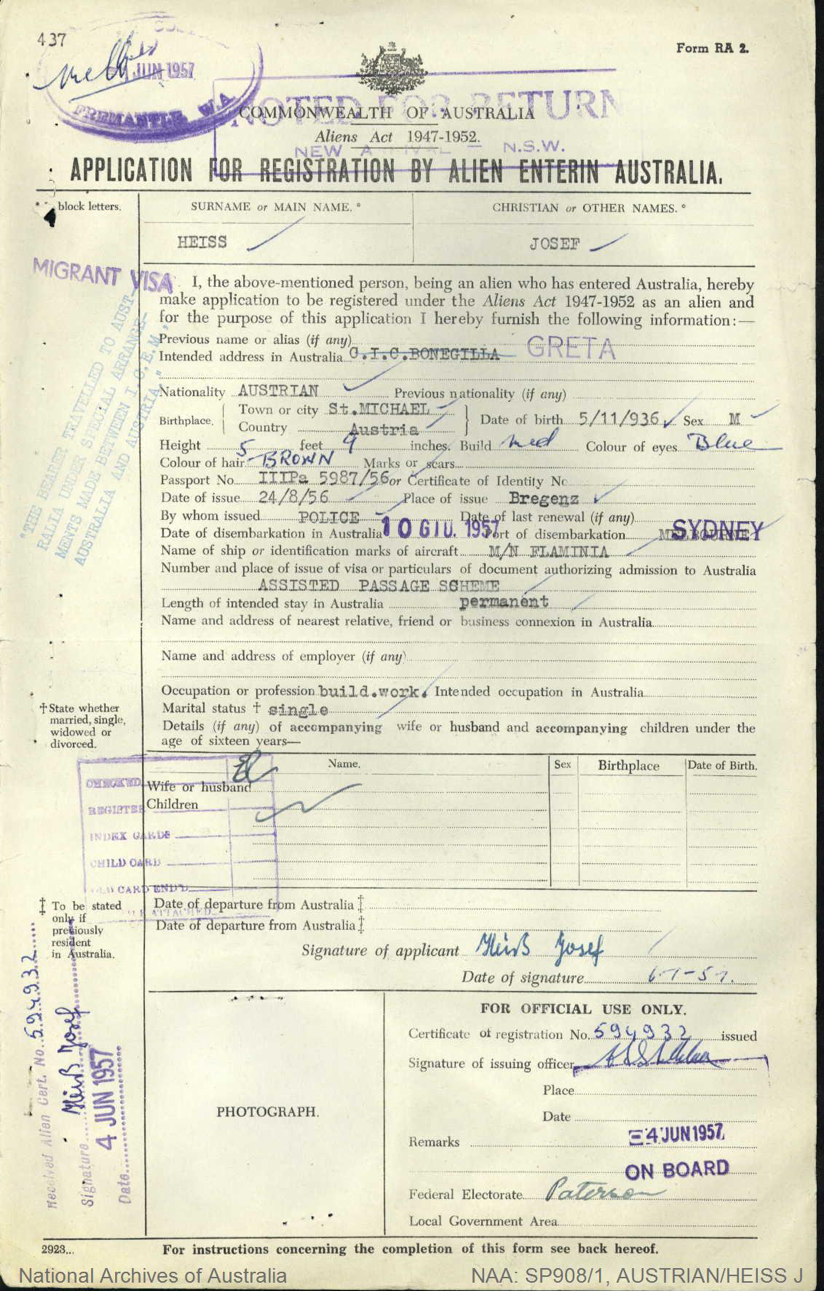
Figure 5 - Extract of entry record into Australia as an alien migrant under the “assisted passage scheme” for Josef Heiss jnr showing his birth details. Source: National Archives of Australia, NAA 7796467 & 30216055
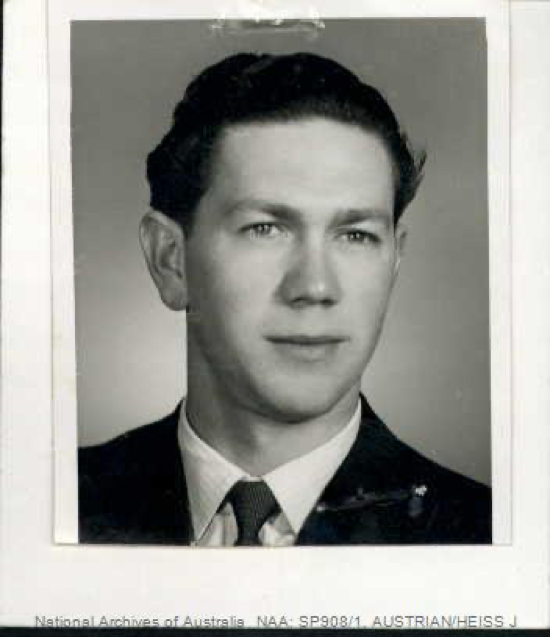
Figure 6A - Photograph of Josef Heiss jnr from his “assisted passage scheme” file. Source: NAA 7796467 & 30216055
Figure 6B - rear of photograph of Josef Heiss jnr from his “assisted passage scheme” file. Source: NAA 7796467 & 30216055
4) Using a genealogical researcher in Austria, we were able to source a copy of the page in the public marriage register of the Catholic church in St. Michael’s im Lungau where Dr Anita Heiss’ grandparents, Josef Heiss and Maria Pfeifenberger, married. It is in German and it is not the formal marriage certificate, but rather a copy of the official marriage register held at the church where they married in 1933. (Figure 7)
We have translated into English the relevant parts of the record (shown in red text, and expanded in Figure 8). These show that this Josef Heiss married a Maria Pfeifenberger in “St Michael i Lg” [in Lungau region of Salzburg, Austria] and that he was a born on “25th Nov 1905” and was a “bricklayer” by trade. [Note that the family name “HeiB” in German is translated to “Heiss” in English]
This is enough evidence to confirm that this particular “Josef Heiss” was Anita’s Austrian grandfather - this independent documentary evidence matches what she believed herself, as she recorded in her own book above, and what her father Josef Heiss jnr included on his 1960 Australian marriage certificate. This branch of Anita Heiss’ family tree is summarised in Figure 9.
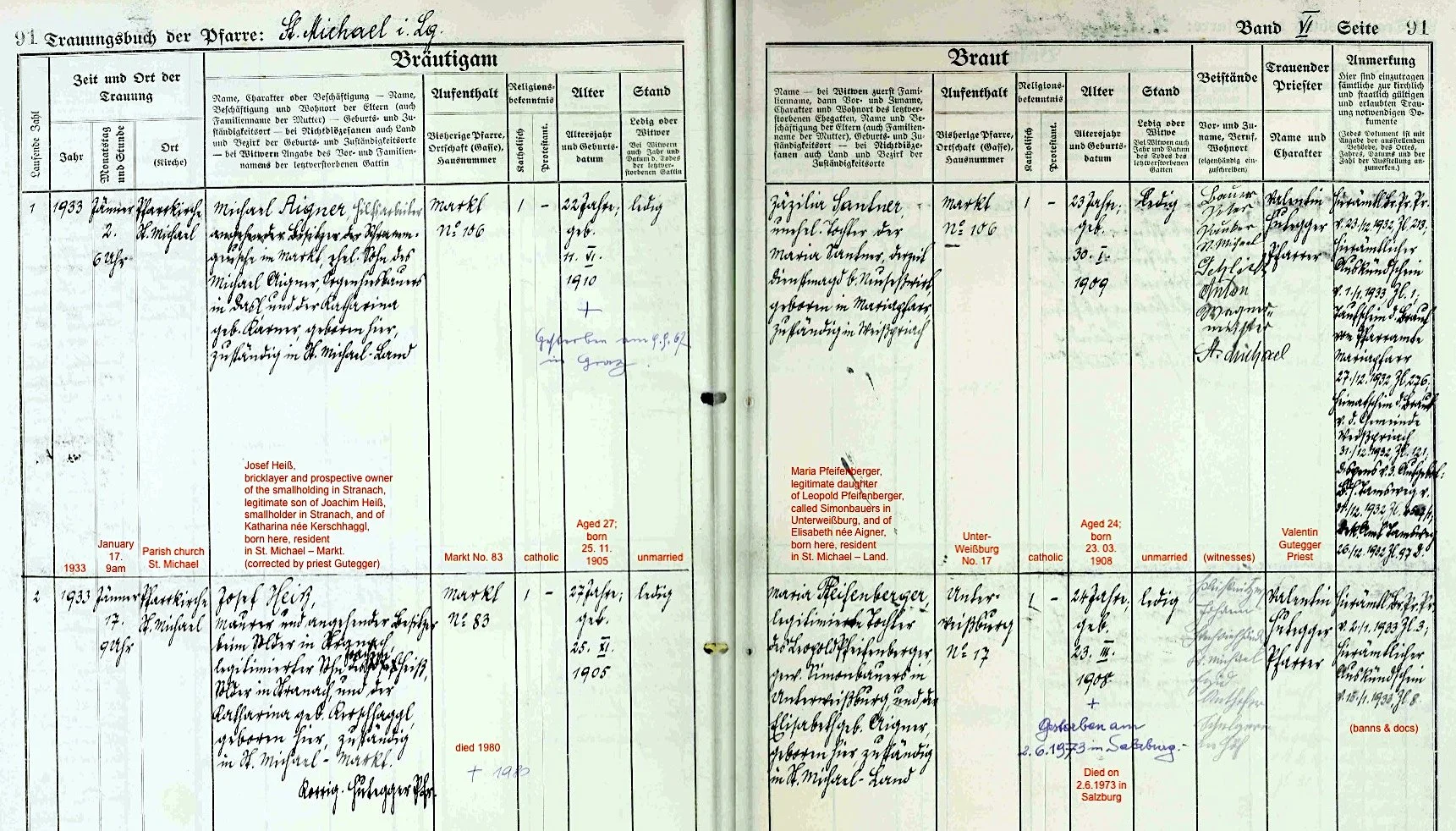
Figure 7 - Copy of a page in the marriage register of the Catholic church in St. Michael’s im Lungau where Anita’s grandparents, Josef snr and Maria, married in 1933. The text in red is the English translation of the relevant parts of the record (further expanded in Figure 8 below). These show that this Josef Heiss married a Maria Pfeifenberger in “St Michael i Lg” [in Lungau region of Salzburg, Austria] and that he was a born on “25th Nov 1905” and was a “bricklayer” by trade. [Note that the family name “HeiB” in German is translated to “Heiss” in English]. Open Source: Church Records St Michael.

Figure 8 - Expansion of red text translation for Figure 7 above.
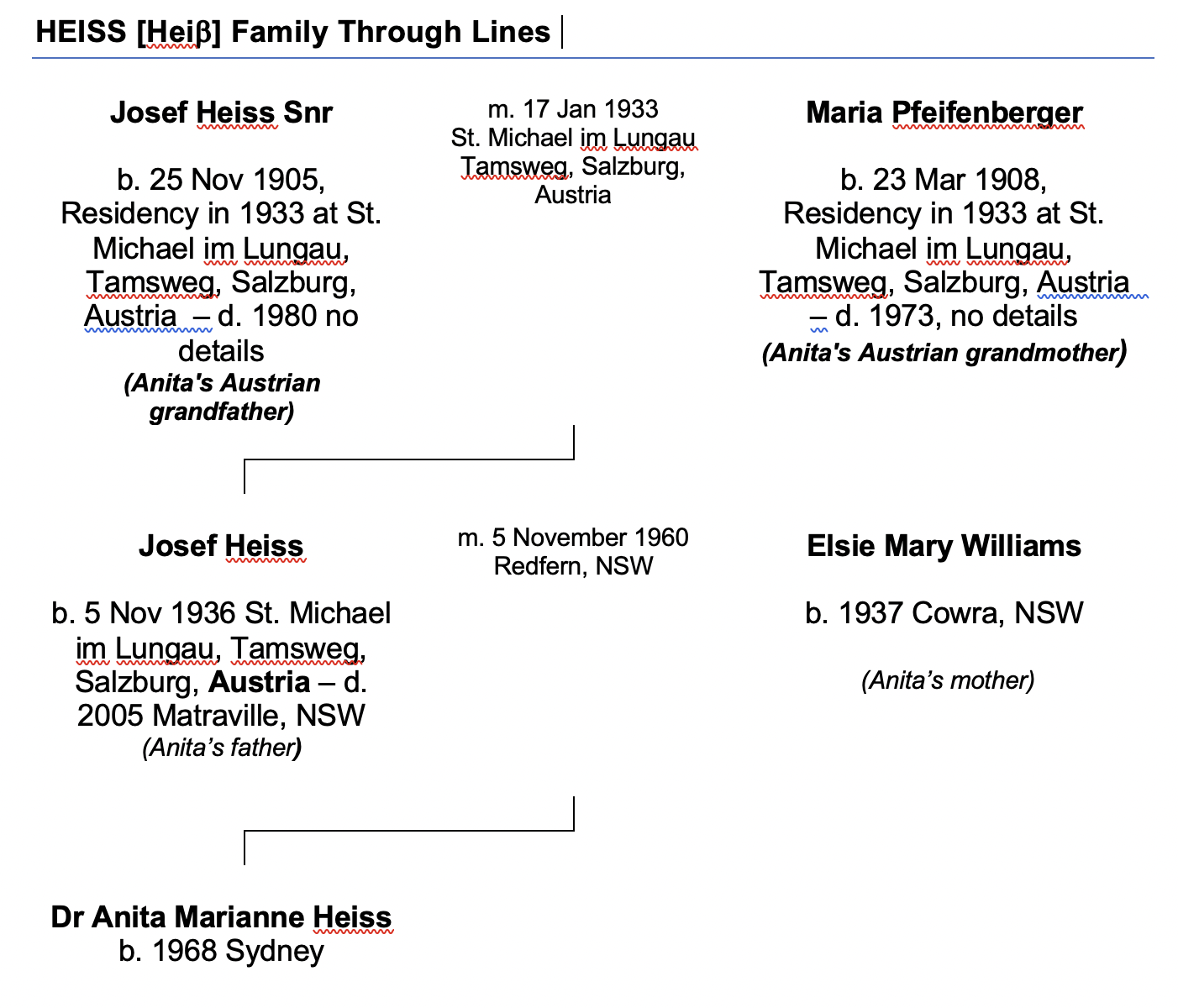
Figure 9 - A branch of Anita Heiss’ apparent Family Tree showing her ancestral line to paternal her grandfather Josef Heiss snr. Source: Public records
5) These documentary links, plus the following analysis, confirm that Anita Heiss’ grandfather, “Josef Heiss snr”, is the same man as the “Nazi party Josef Heiss” - the Australian evidence supplied by his son Josef Heiss jnr matches the Austrian evidence supplied by St Michael Church records, which in turn matches the Nazi-Party archives - his village and his birthdate are the same.
In the small village of St Michael im Lungau, Salzburg, Austria in the 1930s there can only have been one man named Josef Heiss who happened to be born on 25th November 1905. St Michael consists of only a few thousand people [Note 5] and the chance is negligible that there are two different men living in St Michael in the 1930s, who both happen to be named Josef Heiss, and who both happen to be born on the same day in 1905.
We know that the “Josef Heiss” in the St Michael Church records is the same man as “Josef Heiss snr” who is Anita’s grandfather. [He marries the same woman “Maria Pfeifenberger” and he is a “bricklayer” by trade - the information is the same in the St Michael Church records as what Anita’s father declared on his Australian marriage certificate in 1960.]
Importantly, the “Josef Heiss” in the Nazi archives was living in St Michael im Lungau, Salzburg, Austria in the 1930s and was born on 25th November 1905. This must be the same man as Dr Anita Heiss’ grandfather (See Note 6).
This research verifies by independent and corroborating sources that, beyond any reasonable doubt, Dr Anita Heiss’ grandfather Josef Heiss snr was a card-carrying Nazi party member in Austria from at least 1938 to 1942.
The ultimate irony of the Eatock v Bolt court case is thus extraordinary:
The accused Andrew Bolt was smeared as having Nazi-like sympathies by a Jewish lawyer in front of a Jewish judge on behalf of an accuser who, as it turns out, is a descendent of a real-life, card-carrying member of Adolf Hitler’s Nazi party! Anita’s grandfather even sported a Hitler moustache to boot!
You just couldn’t make this stuff up - unless of course the whole court case was a calculated stitch-up of Andrew Bolt and his free-speech from Day One.
Readers should not take these revelations that we in any way suggest Dr Anita Heiss is a Nazi herself, or even has Nazi-like affiliations or proclivities. We subscribe to the notion that the ‘sins of the father are not the sins of the son [granddaughter]’.
But we do note that before activists like Dr Heiss engage Jewish senior counsel to attack others for Nazi-like proclivities, they might want to check their own cupboards first for Nazi-skeletons and sympathisers.
Furthermore, we can only speculate as to whether Dr Heiss was aware of this side of her family history as she strode into court to participate in a court case that now appears to have all the hallmarks of one designed to bring Andrew Bolt to heel, by whatever means necessary. It’s interesting to ponder as to whether a young Anita ever asked the question all kids of our generation enquired of their parents, “Dad, what did grandad do in the War?”
In summary, we believe this information is just further mounting evidence that this court case was all about muzzling commentators like Bolt using the battering ram of section 18C of the Racial Discrimination Act - a campaign where activists and their lawyers convince themselves the ends justify whatever means necessary ‘to aggressively pursue [their] political goals’. No need to let the smell of a real Nazi in her family get in the way of a self-righteous cause.
So was this a case where, as Dr Heiss tells us, “victory was always about what I believed was morally right, not simply about winning a fight”, or was it actually the reverse of what she claimed - winning at all costs and real justice be damned? [Note 7]
Notes
Note 1 - Am I Black Enough for You? - 10 Years on, Vintage Books Australia, 2022, p340.
Note 2 - Eatock v Bolt, Trans. Proc., Fed. Court (Vic) O/N 160844, Mon 28 Mar 2011, Day One.
Note 3 - Eatock v Bolt, Trans. Proc., Fed. Court (Vic) O/N 160844, Day Two, 29 March 2011, p28.
Note 4 - ABC News. Angry Bolt rejects ‘eugenics’ claim, 29 March 2011.
Note 5 - the Google AI answer to the question: “st michael salzburg population 1945” is:
“Because 1945 census data for rural Austrian municipalities is limited, the population of the market town of St. Michael im Lungau (in the province of Salzburg) is estimated at roughly 2,000 to 2,500 residents at the end of World War II, growing to approximately 3,500+ residents today.”
Note 6 - Given that some might consider it confronting to find that an ancestor was a card-carrying member of the Nazi Party, we have provided the results of our research into Josef Hess snr to Dr Anita Heiss (via her literary agent) ahead of its public release. There was a good chance that Dr Heiss was already aware of this aspect of her family history, but in case she wasn't, the respectful position to take was for DEE to provide her this advance notice of publication.
We also stressed in our communication with Dr Heiss that the research work done by DEE is not in any way to be regarded as a personal critique of Dr Heiss herself - we are not in any way suggesting Dr Anita Heiss is a Nazi herself, or even has Nazi-like affiliations or proclivities. Rather, this work is strictly limited to a critique of the writings, life stories and political opinions Dr Heiss herself has first freely put into the public square, and which many Australians find hurtful and denigrating to them, their society and its history.
Note 7 - Other commentators as well have noticed this political perversion of the well-meaning intent of section 18C of the Racial Discrimination Act. In 2016, five years after Bolt’s court loss, Simon Breheny, the then director of the Legal Rights Project at the Institute of Public Affairs (IPA) noted:
political activists and their lawyers have come to realise that section 18C can be used to aggressively pursue political goals. The case against Bolt was not merely a group of offended individuals making a legal complaint in an effort to remedy personal loss. It is possible that the complainants could have made out a defamation suit against Bolt. But the case was pursued using 18C as a battering ram because of the negative perception that would be created by a breach of the Racial Discrimination Act ... Too often the law is being used opportunistically. Section 18C is being used not as a shield but as a weapon. In silencing, or threatening to silence, opponents in a debate using legal means, complainants remove the possibility of debate. It’s unhealthy and it’s undemocratic.
- Simon Breheny, ‘Repeal section 18C, the ‘Andrew Bolt’ law: it stifles free speech’, The Australian, 5 Feb 2016.
Further Reading
Wartime images of St Michael, im Lungau, Salzburg (1941 & 1943) - Figures 10 & 11.
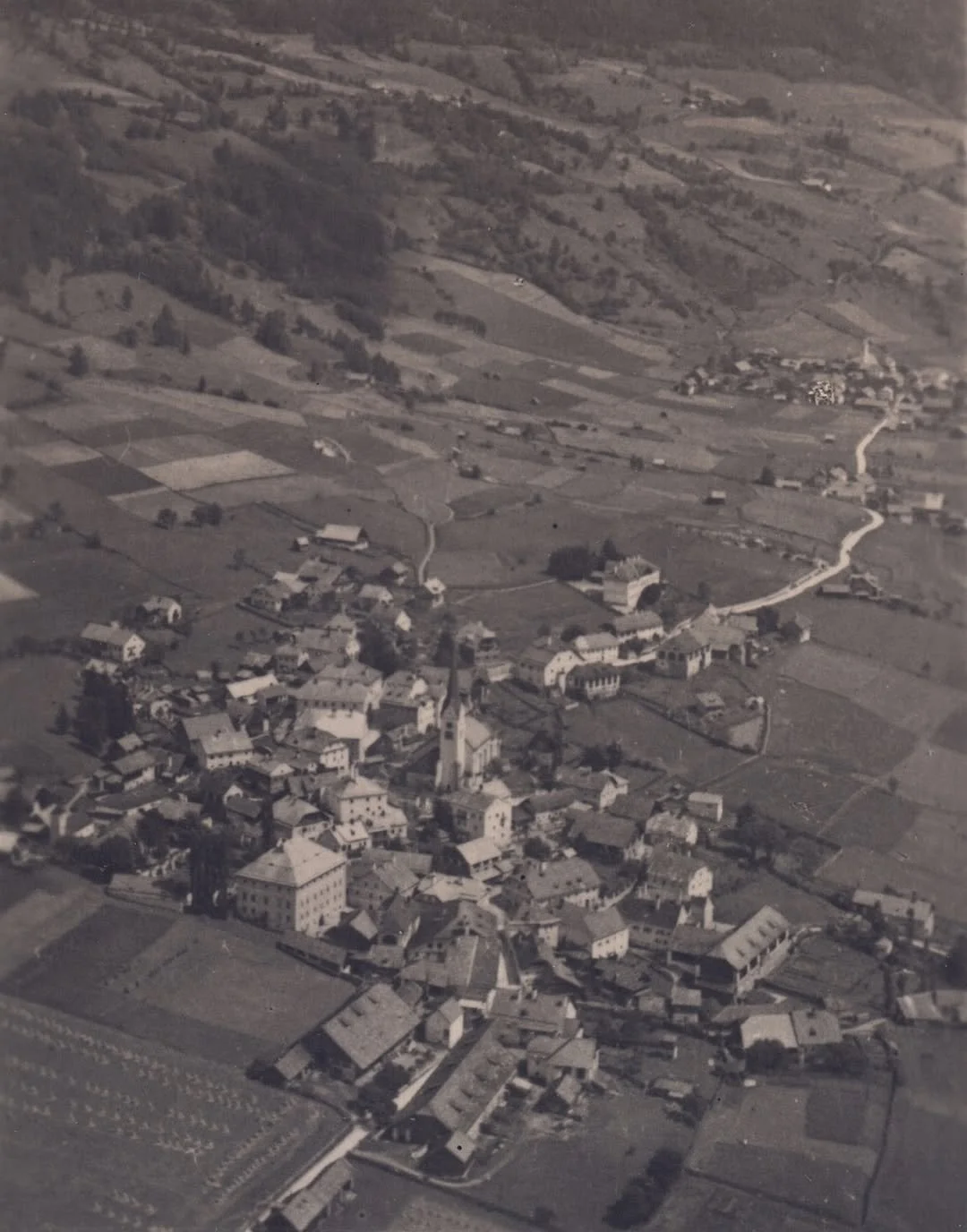
Figure 10 - St Michael, im Lungau, Salzburg, Austria in 1941. Source
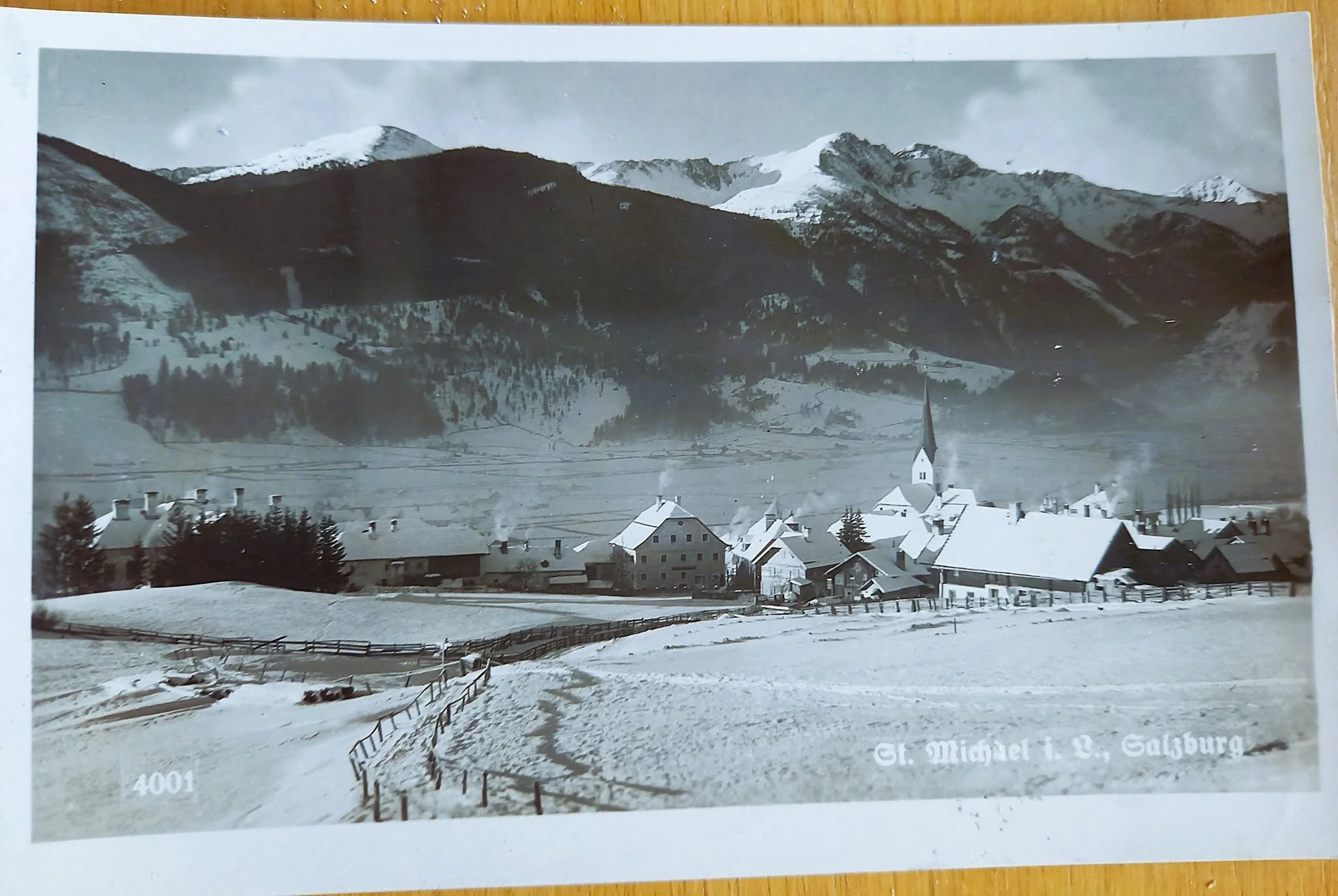
Figure 11 - St Michael, im Lungau, Salzburg, Austria in 1943. Source