Anatomy of a Suspension at the Australian Historical Association - Part 2
Posted 13 Aug 2026
by Roger Karge, Editor
This post is Part 2 in the saga of my 14-day suspension from the 45th Australian Historical Association (AHA) Conference, held at Macquarie University on 28 June to 3 July 2026.
Part 1 in this series laid out the background to the suspension.
This Part 2 takes up the events from when I received notification of the Special General Meeting of the AHA, at which I was offered the opportunity of ten minutes to present my case to appeal my suspension; a suspension for which I had been provided no specific reasons or details.
The meeting was to be via Zoom and the following SGM agenda was emailed to me on 27 July 2026 (Figures 1A&B):
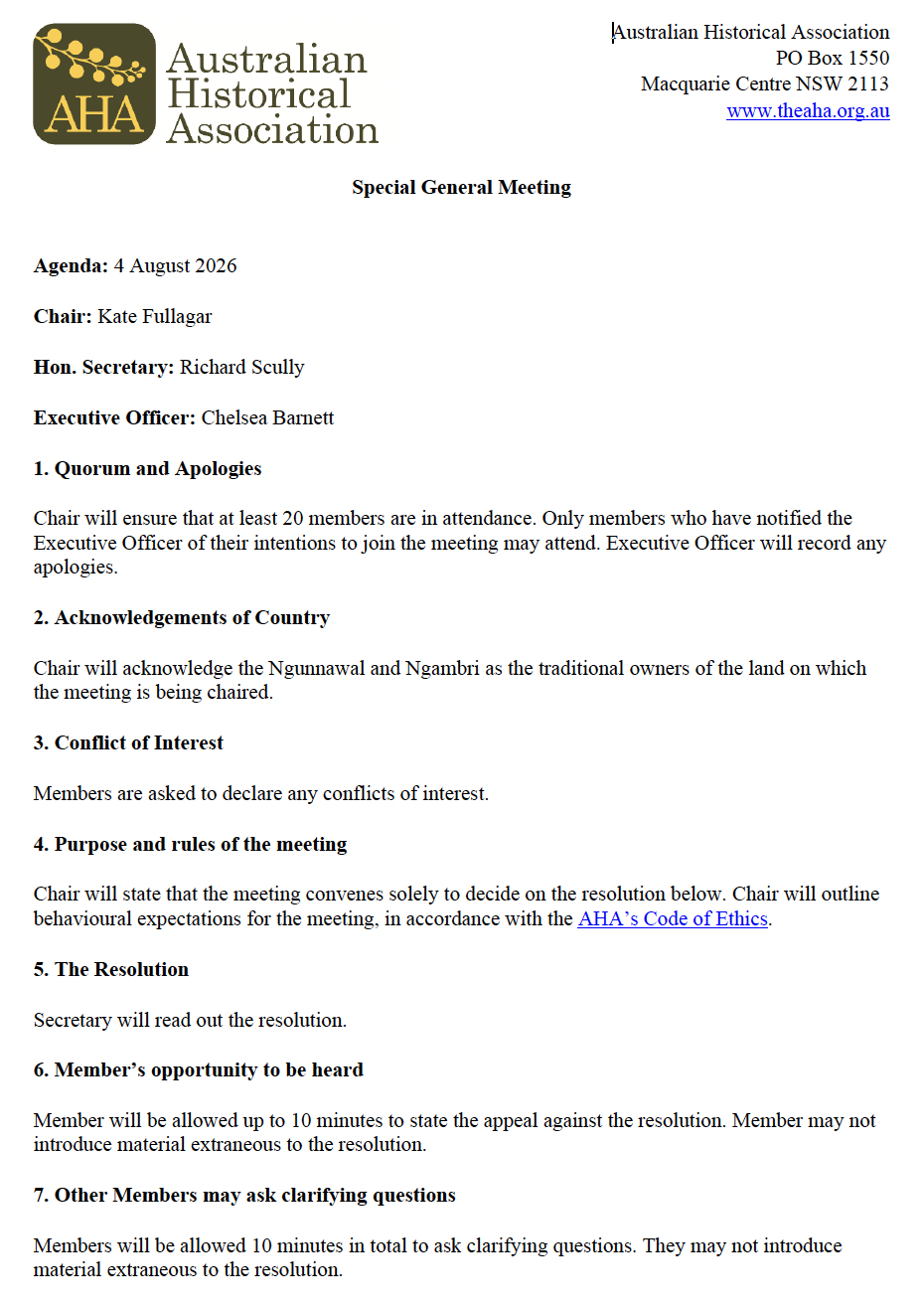
Figures 1 - SGM of the AHA to hear appeal by Roger Karge against his 14-day suspension
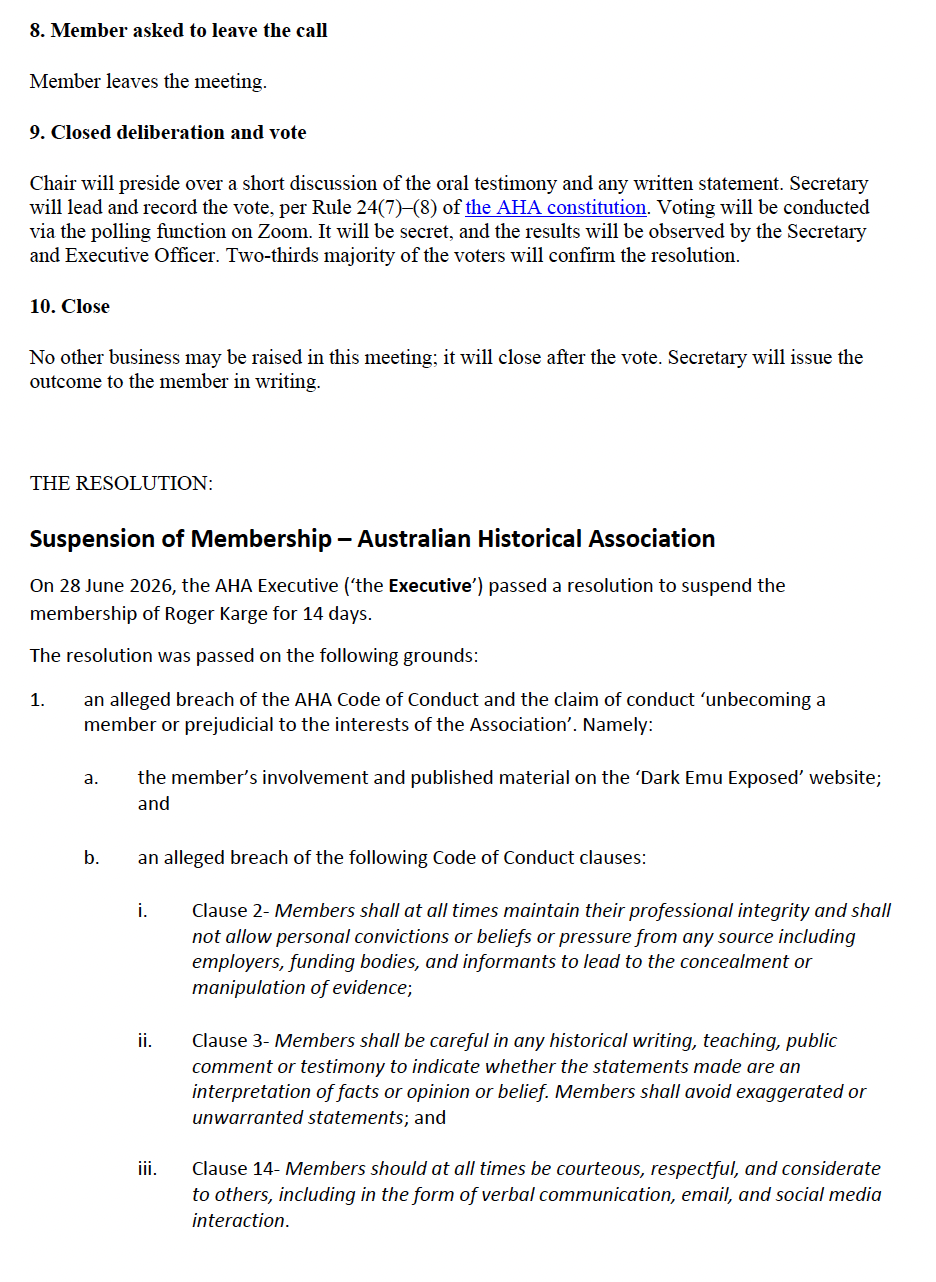
Figure 1B
The Zoom meeting opened with myself and some five members of the AHA committee being visible - Kate Fullagar as chair and Richard Scully as Secretary with at least three others including the President of the Association Professor Michelle Arrow.
I understand that another 90 AHA members had dialled in, but they were hidden from my view.
Given that the Chair informed the meeting that recording was not permissible, the following summary of events is based on my recollection, scribbled notes and that of other members who kindly supplied me with their versions after the meeting ended.
Broadly the meeting went as follows:
The Chair, Kate Fullagar, stated that this meeting was “only about the code of ethics in the practice of history.” It was about conduct unbecoming to a member of the AHA, nothing else. It was about the code of ethics - integrity, honesty, respectfulness. A complaint(s) was said to have been received alleging my conduct made some unidentified members feel ‘‘culturally unsafe.”
During the meeting, member’s questions could be put into the ‘chat’ function, but they were vetted and only the relevant (accepted?) ones were read out. This was viewed by some as a kind of technical disaster - for example, one questioner could not see his submitted comment but the executive panel could and they decided which questions would be acknowledged. One questioner wrote something which the executive panel denied they could see. Some members felt this lack of transparency in questioning created the impression that the meeting might have been influenced (rigged?) to push a particular end result, not unlike how some ‘union meetings are run.’
Roger Karge (RK) then spoke. He said he had no idea as to why he had been suspended from the conference. His intended conference talk was simply about historiographical methodology. He had written a book that had been reviewed and debated in the Tasmanian Historical Research Association (THRA) journal and the next logical step, he thought, was to present a related paper on his methodologies at the AHA Conference, before a much larger, more influential audience of historians. His suspension however was not related to his submitted conference paper but rather related to his association as editor of the Dark Emu Exposed (DEE) website. RK explained that DEE was not strictly academic; the language used for that website’s demographic was different to the language he would use at the conference; a lot of people participated in DEE & he didn't write everything on it.
The secretary answered that he (RK) was associated with the website and the content. He (RK, thus) didn't demonstrate care with his opinions on the website. There were exaggerated statements. There were threats - “fakes, we are coming for you”, etc. RK replied that obviously he would not speak like that at a conference, he wanted to discuss methodology.
The meeting opened to questions. RF wanted to know “what were then the bounds of public and private for the AHA”. N asked was it “the same as the writer's festivals where people were cancelled”, the implication being that, wasn’t the AHA being hypocritical when it complained when certain writers were cancelled at the writer’s festivals but here was the AHA doing the same thing to RK. Is it fair to use Use Codes of Conduct to control/stifle debate?
The Chair said she did not know about writer’s festivals, this was the first time anyone had been suspended and it was only for two weeks. RK was still a member. T asked why the suspension was for two weeks? [no answer was noted] NP asked about expulsion - why is RK being just suspended, shouldn’t the AHA be considering expelling RK? - the answer was that the resolution under question was concerned only with suspension for 14 days. A new resolution would need to be put for an expulsion was to be considered.
The Chair talked about the changes to the privacy act in late 2024 where doxxing and showing people's personal data would result in 6 years jail. [RK privately took this as a veiled threat to discourage the genealogical work at DEE]. RK replied the lawyers had checked everything and they were within the Act, but he realised the language on some posts may be considered by some to be overly strong and he'd investigate those webposts and tone it down if required.
The Chair mentioned that specific complaints had been received about DEE’s treatment of Professors Jaky Troy and Lisa Jackson Pulver, both of the University of Sydney. Also complaints had allegedly been received regarding some of the methodology openly used on DEE as being of a form of “baiting” and “entrapment.” [This perhaps is related to DEE investigations into claims by Professor Megan Davis which ultimately confirmed the professor was in error ].
RK was given another 2 minutes [his ‘talk-time’ appeared to have been monitored and it had not yet reached the allotted 10 minutes]. He spoke generally of the parlous state of history education in Australia, with its diminishing funding & employment opportunities. He spoke of acting in good-faith to help re-invigorate debate in history issues [to make the study of it more relevant in the public’s mind] even if some issues were perceived to be politically contentious. RK then left the meeting.
Further questions involved: “was Roger warned before suspended?" The Executive said it did raise the issues prior [I dispute that - see Part 1 for correspondence where no specific details of the complaints were relayed to me prior to the suspension]. The conference was another matter. AH wanted Karge removed completely from AHA.
The secret vote then occurred. The results came up on screen - 63% said yes Roger should have been suspended; 23% said no he shouldn't have. 11 notified they had abstained based on unstated ‘conflicts of interest’ (whatever they may have been?)
A few days after the meeting Roger Karge was emailed the results by the AHA Secretary (Figure 2):
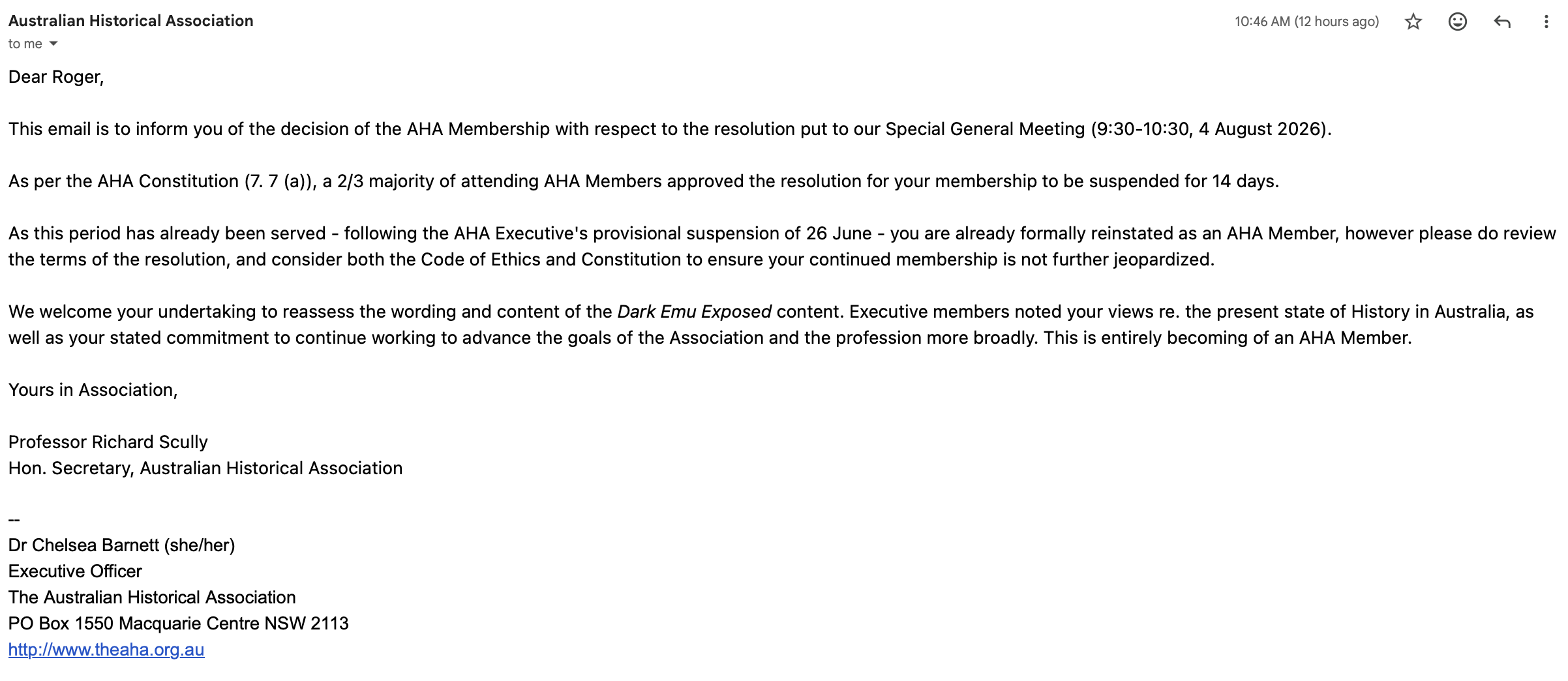
Figure 2 - Notification to uphold the 14-day suspension
Roger Karge’s Analysis
My summary of this sorry affair is as follows:
1. I believed the Executive have been clumsy in their handling of these events. The great irony is that while they accuse me of bringing the AHA into disrepute, the Executive’s own ham-fisted handling of my suspension has potentially brought the AHA into much greater disrepute within the mainstream media. I’m just an obscure member of the AHA, but the Executive’s actions have, I believe, caused much more reputational criticism of the AHA than my short 20-minute talk at the conference could have ever achieved.
2. I honestly believe that the knowledge of the methodology I was to present in my paper would have been of great use to audience members keen to improve their own historiographical skills. The results in my paper would have also added important understandings to the 250 year history problems of the Risdon Cove affair - minds would have been changed, as the conference theme exhorted its participants to explore.
3. A number of observers have now expressed to me that the AHA appears to have compromised itself. It has done reputational damage to the notion of academic free-speech in this country. It has shown itself not to have had adequate procedures in place to handle what may have been complaints worthy of address. Instead, it resorted to the same Kafkaesque-style, blanket cancellation and no-platforming policies that other organisations have rightly been criticized for.
4. And most importantly, I believe the AHA, by its actions in my case, has shown an inability to understand and address the causes of the decreasing interest in the history profession, the lack of funding and the loss of respect that we see in Australia, year by year. The publicity generated by my suspension is only going to add to history’s demise within the public’s (and the taxpayer’s) mind.
5. Nevertheless, I am still appreciative to be a member of the AHA and I intend to make what contribution I can, acting in good faith, to influence the functioning of the AHA in its aim to improve the history profession’s standing within the community.
To this end, one need not look beyond the AHA’s own admission that some things need to change, as outlined by Martin Crotty, Associate Professor of History at the University of Queensland who wrote the following in the AHA’s own journal two years ago*:
Australian Historical Association conferences are usually a time of celebration … But we cannot just pretend that all is well. Without wishing to induce despair, which is of little use in any case, we need to bell the cat.
Notwithstanding the quality work produced by members of our discipline, and cognisant of the bright young faces that evidence a never-ending flow of new and emerging talent, we are a discipline in decline. We need to acknowledge this, face up to it, and do what we can to reverse what is now a well-established trend.
This forum was initiated as something of a conversation starter – a way to share awareness and develop a wider understanding of the problem, and to begin the process of developing strategies to turn the situation around…[for which] we need a clear strategy…There are fewer and fewer positions in History, and there are fewer students… The main game – the History discipline and its staff and students – needs urgent and sustained attention.
* Crotty, M., (2024) Addressing the decline of academic history in Australia, History Australia, 21:4, 522-525,
In my opinion, channelling the theme of this year’s conference, there are many reasons as to why the AHA Executive itself needs to “Change its Mind” over the direction of the AHA.
In my next and final Part 3 in this series, I will explore and discuss this need tor change at the AHA. I will also address in more detail the Executive’s two stated reasons for my 14 day suspension: that my conduct was “unbecoming a member or prejudicial to the interests of the Association” - it was about the code of ethics - integrity, honesty, respectfulness, and that I was associated with a website known as Dark Emu Exposed.