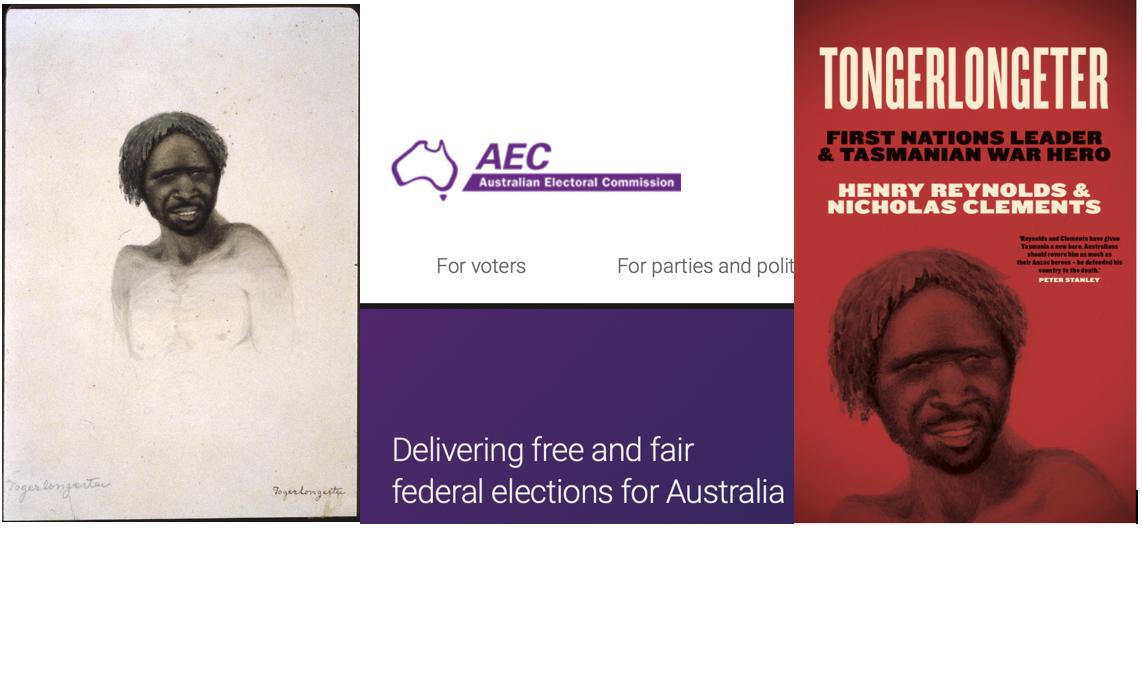
The AEC's Problematic Tongerlongeter - War Hero or War Criminal?
Posted 21 Jul 2026
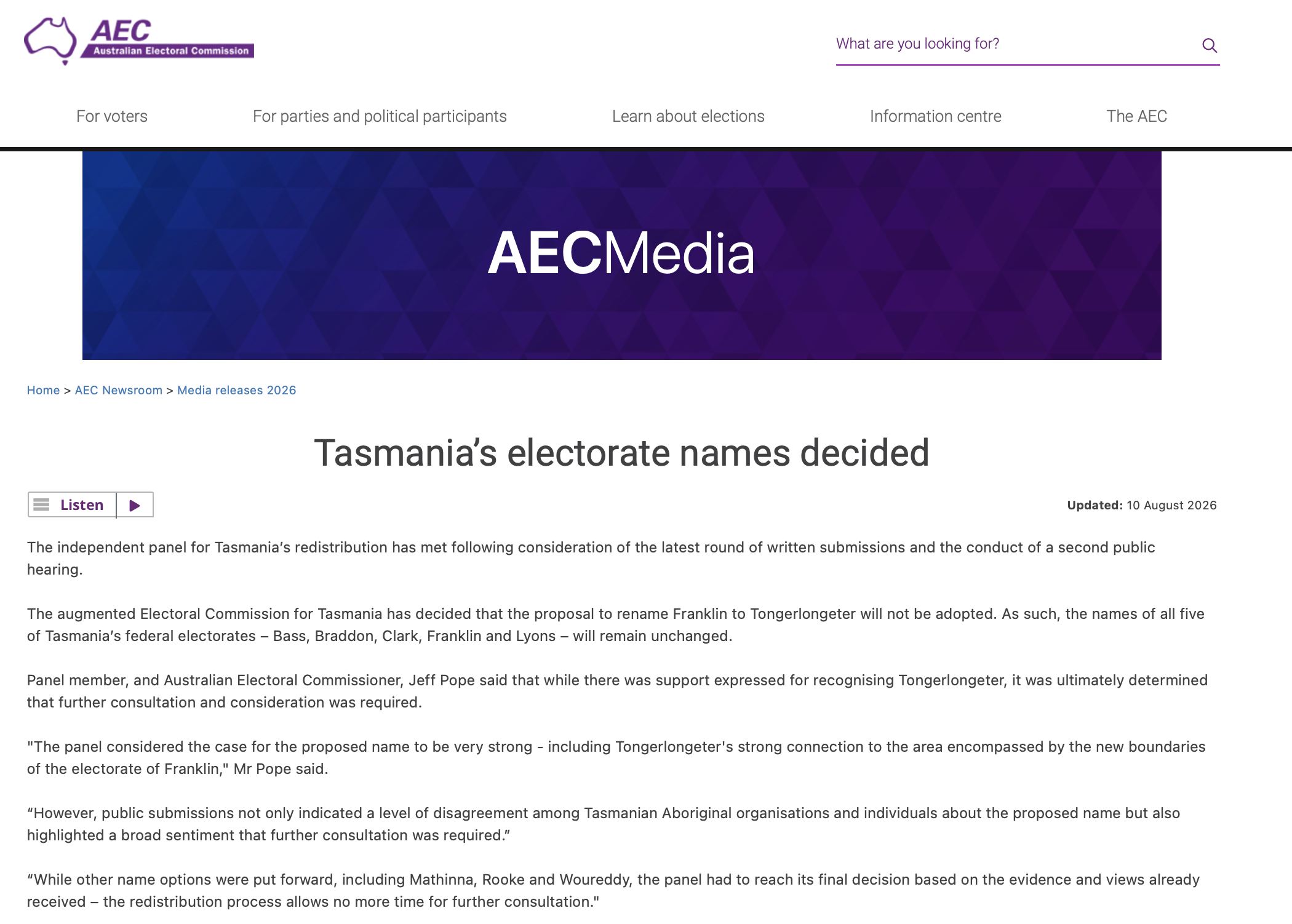
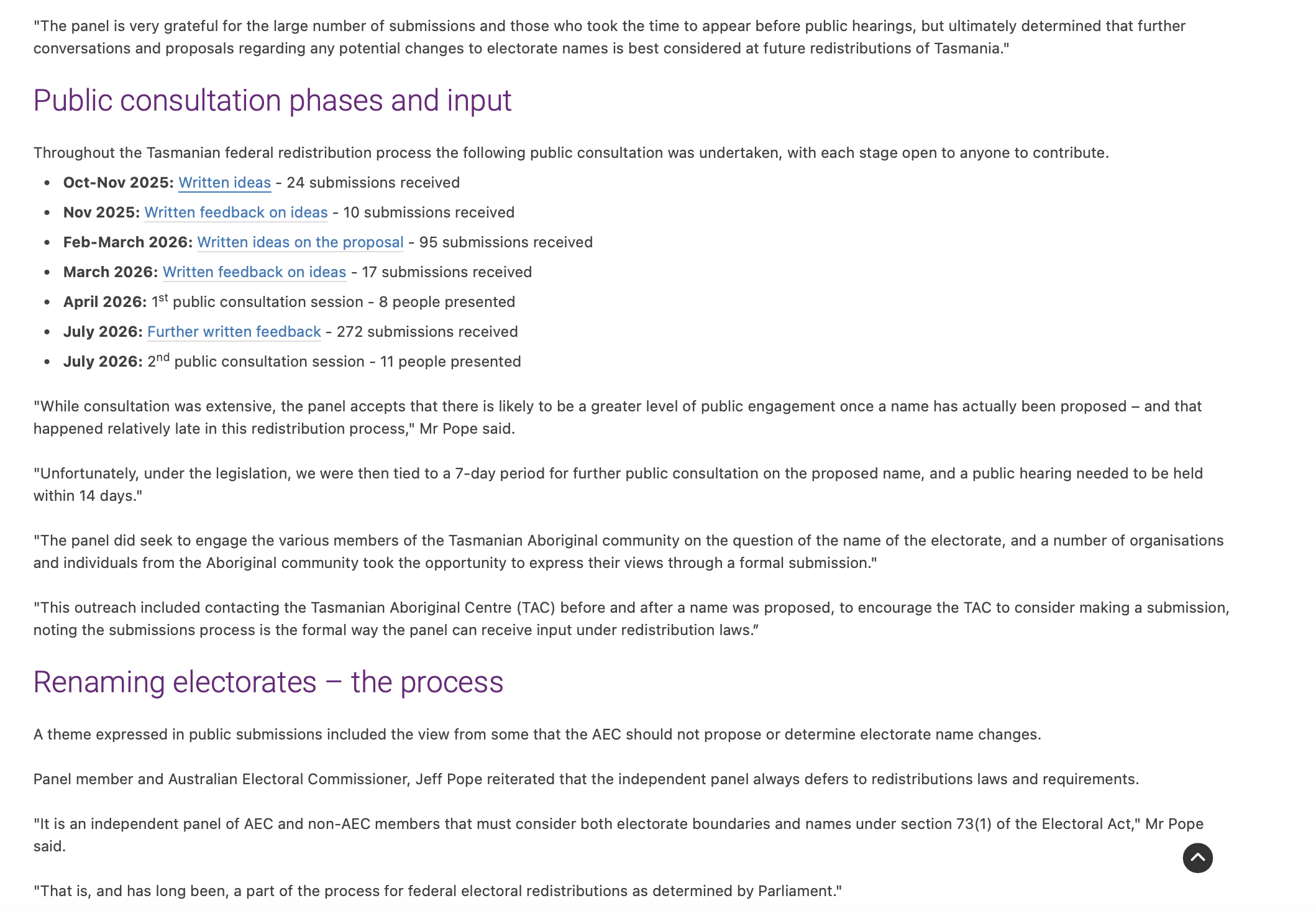
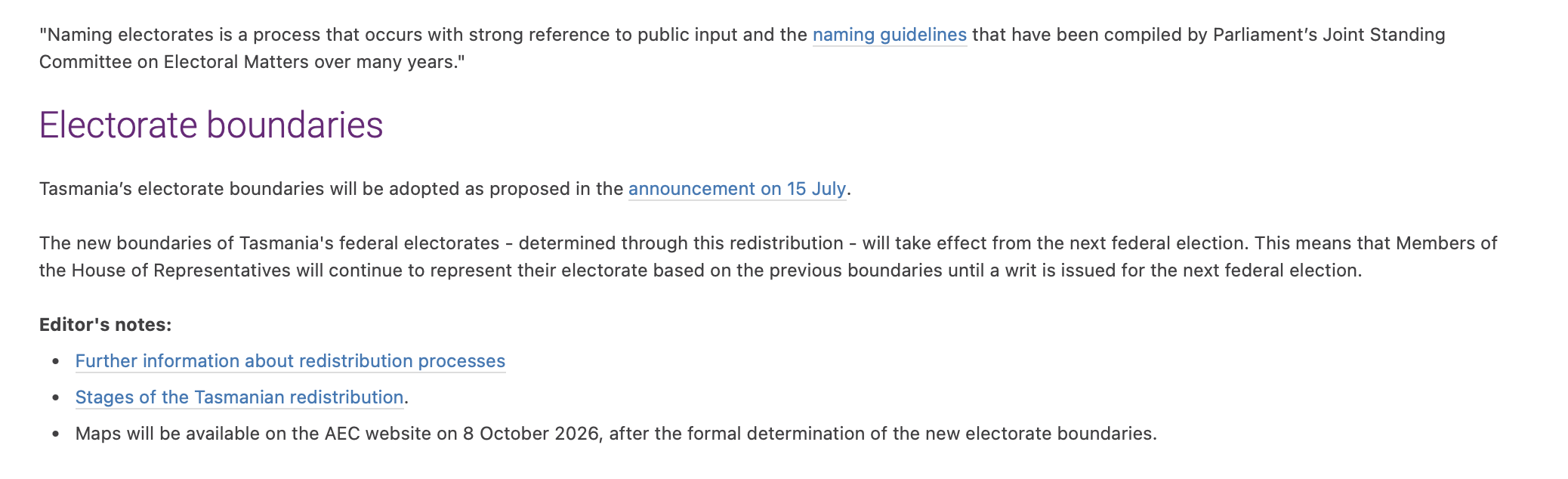
Updated 10 August 2026 - Name Change Proposal Failed
- Franklin to be retained (See end of post)
The Australian Electoral Commission (AEC) announced the following proposal for an electorate name change and gave only 6 days for the public to respond by submission to support or oppose the nomination.
The augmented Electoral Commission is proposing that the reconfigured electorate of Franklin be renamed in honour of Tongerlongeter.
The augmented Electoral Commission acknowledges the name Franklin has been in continuous use for more than 120 years. It acknowledges the contribution to the development of colonial Tasmania of Sir John Franklin KCH RN, a British naval officer, Arctic explorer and colonial administrator who served as Lieutenant-Governor of Van Diemen's Land from 1837 to 1843. Sir John Franklin’s name is recognised elsewhere across Tasmania and internationally.
Following its deliberations, the augmented Electoral Commission proposes renaming the electorate of Franklin in honour of Tongerlongeter (c. 1790-1837), a Poredareme man of the Oyster Bay nation and a prominent Aboriginal leader whose Country encompassed much of south-east Tasmania, including areas within the reconfigured electorate boundaries. The name ‘Franklin’ is proposed to be retired.
Tongerlongeter is recognised by historians as one of the most significant Aboriginal leaders in Tasmania during the early period of British colonisation. During the Black War, he emerged as a leader of the federation of Oyster Bay clans and played a prominent role in Aboriginal resistance to colonial expansion. Working with allied groups, including the Big River nation, he led efforts to defend Country and resist the impacts of settlement.
Historians regard the scale and effectiveness of Aboriginal resistance under leaders such as Tongerlongeter as a significant factor in major colonial government responses, including the declaration of martial law in 1828 and the Black Line campaign in 1830. In 1831, Tongerlongeter met with Lieutenant-Governor George Arthur as colonial authorities sought to end the conflict. He and surviving members of his community were subsequently relocated to Wybalenna on Flinders Island.
Below is the Dark Emu Exposed submission opposing the name change:
Submission to the Australian Electoral Commission (AEC)
Re: Objection to the proposed use of the name Tongerlongeter for the reconfigured electorate of Franklin in Tasmania
Submission by: Mr Roger Karge, Melbourne
I thank the AEC for the opportunity to make this public submission. I am a Melbourne-based scientist, businessman and frequent commentator in the media on the topics of free-speech, Aboriginal and colonial history and their modern-day societal impacts (Note 1).
Background
The AEC advises that its electorate naming policy contains these aims:
1. Every effort should be made to retain the names of original federation electorates;
2. Names of electorates should not be changed or transferred to new areas without very strong reasons, and
3. Usually, electorates should be named after deceased Australians who have rendered outstanding service to their country. - AEC Electoral Division Naming Guidelines
It is my contention that replacing the electorate name of Franklin with Tongerlongeter fails to meet these three policy guidelines.
Additionally, as a fourth point, Australia is the tenth-oldest democratic nation in the world, and we are all rightly proud of the AEC’s long tradition as a non-partisan, professional and trusted institution that has managed to deliver the franchise successfully in Australia for decades.
I believe that replacing the electorate name of Franklin with Tongerlongeter may threaten the perception of the integrity and impartiality of the AEC. Not only must the AEC always be politically impartial, it must also be seen to be politically impartial.
My Reasoning
In addressing these four points I note that:
1. The Federal division of Franklin was one of the five established when the former Division of Tasmania was redistributed on 2 October 1903. Thus, the division name of Franklin has a long pedigree, back to close to Federation.
2. There is no valid, pressing reason to change the electorate’s name to Tongerlongeter beyond the political desire by advocates to elevate his name to the status of “war hero”. On a per capita basis, Aboriginal and Torres Strait Islander people are already represented in electoral names at a rate that is about double that of the general population of Australia (see below).
3. Advocates of Tongerlongeter refer to him as a “First Nations leader and Tasmanian War Hero.” (Note 2) I will provide evidence here that demonstrates that he could just as validly be described as a “war criminal.”
4. I fear the AEC will jeopardise its well-earned respect for institutional impartiality if it agrees to honour Aboriginal warrior and leader, Tongerlongeter [c.1790-1837], with an electorate name.
In these polarising times, this choice will be seen by many Australians as politically influenced and will leave the AEC open to controversy. I am certain that it will be viewed as a biased political gesture that will inflame, once again, the history and culture wars so prevalent in Australia over the past twenty-five years.
Speaking to this latter point, the proposed name change by the AEC, has already been described as a “change-by-stealth” by former Australian prime minister, the Hon Tony Abbott, who published an opinion piece recently in a leading, national newspaper voicing his concerns. (Note 3)
This publicity should be of major concern to the AEC. When a former prime minister raises these criticisms, the alarm bells should be sounding within the AEC if the organisation wants to retain the public’s faith in its integrity, incorruptibility and impartiality. The AEC must be seen to be sticking to it legislated mandate and avoiding controversial cultural and political decisions wherever possible.
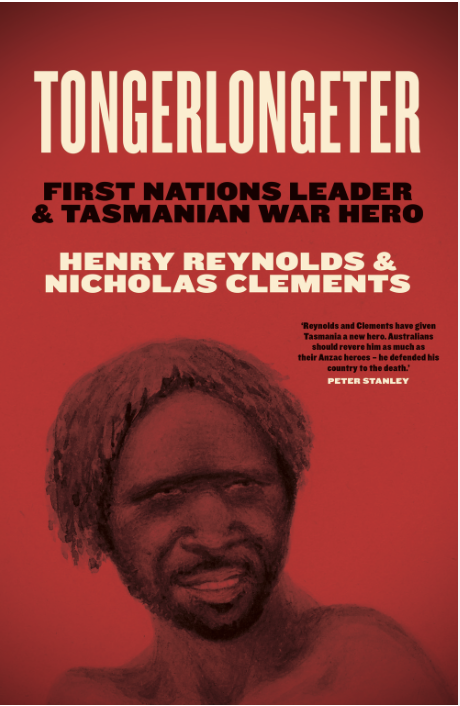
Abbott acknowledges, as I do, the “carefully researched account” of Tongerlongeter recounted in the seminal work on his life by historians Henry Reynolds and Nicholas Clements (Note 2). In his article, Abbott cites Reynolds’ reckoning that,
Tongerlongeter’s bands killed some 180 settlers and seriously wounded as many again. (Note 3)
I now provide further evidence that strongly supports the claim that Tongerlongeter could validly be accused of perpetrating war crimes during his life and, as such, he fails to meet the AEC requirement for being a “deceased Australian who has rendered outstanding service to their country.”
The Evidence
The so-called “resistance” by Tongerlongeter and his band against the British settlement largely consisted of acts of violence against civilians and non-combatants. These acts of violence were classed as illegal at the time. If they were committed today they would be classed as war crimes.
According to the Australian Federal Police website :
War crimes are breaches of the 1949 Geneva Conventions and of Protocol 1 (1977 amendment protocol) and serious violations of the laws and customs of war committed in an international or non-international armed conflict. Offences include:
murder
mutilation
cruel treatment and torture
attacks against civilian populations or non-combatants
sexual or gender-based violence
deliberate population displacement
hostage-taking
pillaging.
I contend that each of the war crimes in bold, above, were committed and/or encouraged by Tongerlongeter himself during his life of “resistance” against the British settlement.
Targetting of Non-Combatants
Reynolds & Clements in their book, Tongerlongeter, freely admit that he and his warriors ‘were wary of the men in red’ - the British soldiers - due to their ‘training and discipline’. The soldiers were avoided as much as possible by Tongerlongeter. Reynolds & Clements even cited an observer at the time recording that the Aborigines have ‘a rooted antipathy to the military’ and ‘an unconquerable aversion to soldiers’ (Note 2, p105-6).
The evidence suggests that Tongerlongeter was more of a ‘bandit’, preying on lone shepherds, undefended huts, women and children, rather than a ‘military combatant’ who sought out engagements with his official enemy, the red-coated British soldiers.
Indeed, Clements has published his research database online which shows that he could locate only six incidents of violence or “resistance” by the Aborigines directly against soldiers. These led to the death of only one soldier and the wounding by spearing of four others. (Table 1)
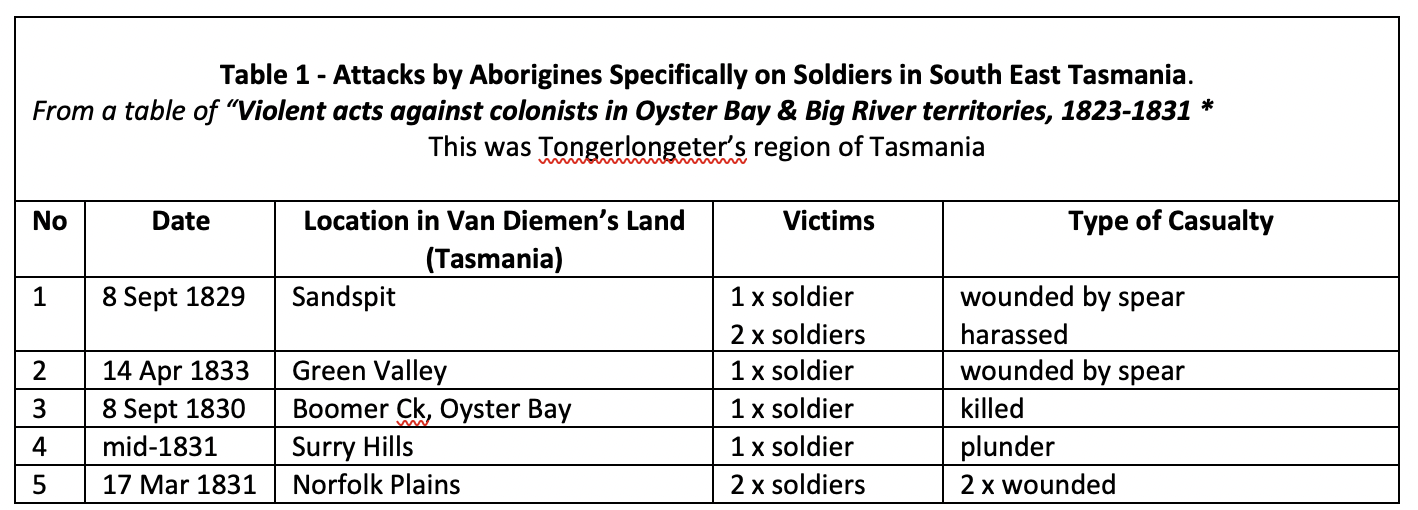
* Source: Nicholas Clements, attacks by Aborigines – “Clements Compendium: PDF database of attacks on and by Aborigines in southeast Tasmania”
This low encounter rate with so-called “enemy soldiers” compares to some 180 civilian deaths by the Aborigines - settlers, including women and children - that Tongerlongeter and his bands were said to have been responsible for. (Note 3) This concentration on targeting and killing civilians rather than soldiers clearly implicates Tongerlongeter’s military style as coming within the definition of war criminality.
Mutilation, Cruel Treatment & Torture
Reynolds & Clements have published considerable detail on the clearly war criminal behaviour of Tongerlongeter, for which they found considerable evidence in the archives. I have included here an extract of their book to illustrate his war criminality:
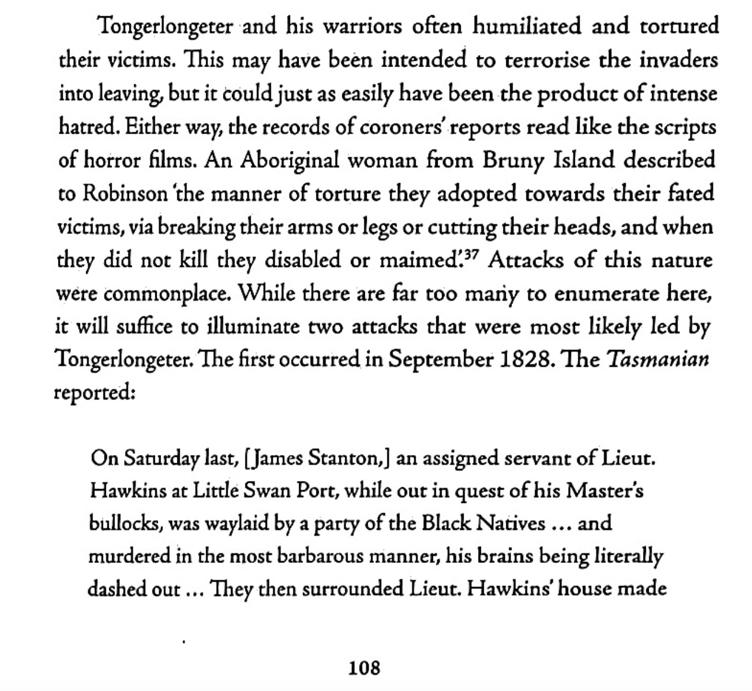
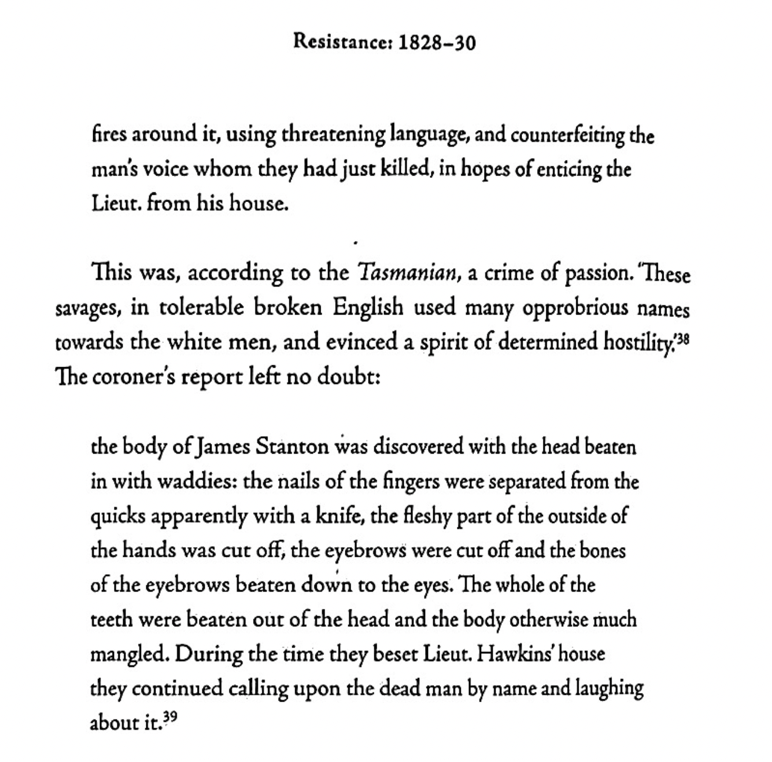
Source: Extracts from Tongerlongeter – First Nations Leader & Tasmanian War hero by Henr yReynolds & Nicholas Clements, Newsouth, 2021, p108-9
Murder of Women and Children
One of the most horrific war crimes perpetrated in Tasmania was that of the massacre of the women and children of the Gough, and another neighbouring, family near Oatlands on 9 Oct 1828. Reynolds & Clements call this attack ‘particularly harrowing’ and, even though they could not locate direct evidence that Tongerlongerter led the attack in person, they believe that circumstantial evidence implicates his involvement. (Note 2, p106-8)
Historian Keith Windschuttle was one of the first to write of this incident:
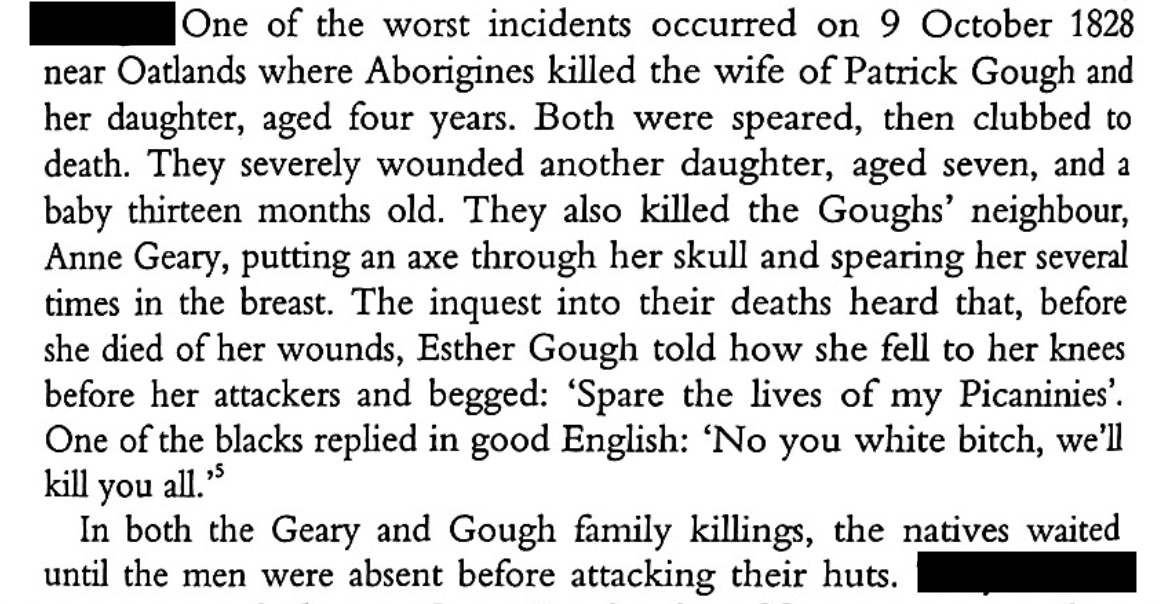
Extract from Windschuttle, K., The Fabrication of Aboriginal History, Vol 1, Van Diemen’s Land 1803-1847, Macleay Press, 2002, p86
The incident is infamous in historical circles for firstly, the quality of the evidence from the records of the inquest and the testimony of one of the victims, Mrs Gough, who was able to relate all the details before succumbing ‘to her wounds three weeks after the attack’, and secondly for the war-criminal-like inspired hatred expressed by one of Aboriginal attackers:
As Mrs Gough lay dying, she told her husband, ‘that she fell on her knees to the natives and said, “Spare the lives of my piccaninnies” and that one of the assailants replied in good English: ‘No you white bitch we’ll kill you all.’ (Quoted by Reynolds & Clements, Note 2, p 108)
For the avoidance of doubt I have included as attachments copies of the original handwritten inquest notes into the Gough killings plus a type-written transcript.
Past AEC Naming Decisions
In 2016 the AEC called for submissions after,
being asked to rename the Victorian federal seat of McMillan to remove links to the murder of Aboriginal people in Gippsland. Liberal MP Russell Broadbent has written to the commission asking for the electorate to be called the seat of Monash. Sir John Monash developed the use of brown coal in the Latrobe Valley as head of the state electricity commission. The seat is currently named after explorer Angus McMillan, who opened up much of Gippsland. "Angus McMillan has a history that is well-documented about his murderous ways in regard to our Indigenous people and it's time to recognise that," he said. - ABC NEWS 31 Mar 2016
The AEC agreed to retire the name “McMillan” due to Angus McMillan’s possible involvement in Aboriginal frontier violence.
I contend, by the same reasoning with regard to Tongelongeter’s involvement in killings, massacres and war-criminal-like conduct on the colonial frontier, his name should not be applied to the reconfigured Franklin electorate.
There are currently 151 electoral divisions with 116 (77%) of them are named after people. Of these 116 divisions, 8 (7%) are named after an Aboriginal or Torres Strait Islander person. This represents about double the number, on a per capita basis, of names being assigned to Aboriginal or Torres Strait Islander people, given that they represent some 3.8% of Australia’s total population. (See AEC video for statistics)
There is currently no lack of recognition of Indigenous Australians in electoral naming and thus no immediate need to prioritise the addition of Tongerlongeter’s name to replace that of Franklin.
Summary
For all the above reasons, Tongerlongeter is far too controversial an historical figure to be considered for an electorate name.
This submission therefore objects to his name being assigned to the reconfigured Franklin electorate.
Yours sincerely, Roger Karge, Melbourne
Notes
Note 1 – Mr Roger Karge is
1. A co-author of the history book Truth-telling at Risdon Cove
2. Author of the book, Witness for the Prosecution on the Eatock v Bolt 2011 court case
3. Editor of the Dark Emu Exposed website
4. Regular contributor in the media on free-speech issues, Aboriginal and colonial history, genealogy and their modern-day societal impacts (see SkyNews Bolt Report appearances here and here, the newspapers, The Australian & The Australian, Australian Financial Review and The HeraldSun.
Note 2 - Henry Reynolds & Nicholas Clements, Tongerlongeter – First Nations Leader & Tasmanian War Hero, Newsouth, 2021. (see also: Clements, N., Friday essay: Tongerlongeter — the Tasmanian resistance fighter we should remember as a war hero, The Conversation online, 6 Aug, 2021)
Note 3 - Abbott, T., Officialdom’s latest change-by stealth: renaming seat of Franklin, The Australian, 17 Jul 2026
Note 4 – Inquest of Gough killings, Tasmanian Archives, CSO1-1-316-7578 pages 166-172.pdf; Type-written transcript of Inquest of Gough killings. First cited by Windschuttle, K., The Fabrication of Aboriginal History, Vol 1, Van Diemen’s Land 1803-1847, Macleay Press, 2002, p86, fn5